What Lies Beneath Skinwalker Ranch? Archaeologist Chris Roberts Breaks His Silence
What Lies Beneath Skinwalker Ranch? Archaeologist Chris Roberts Breaks His Silence
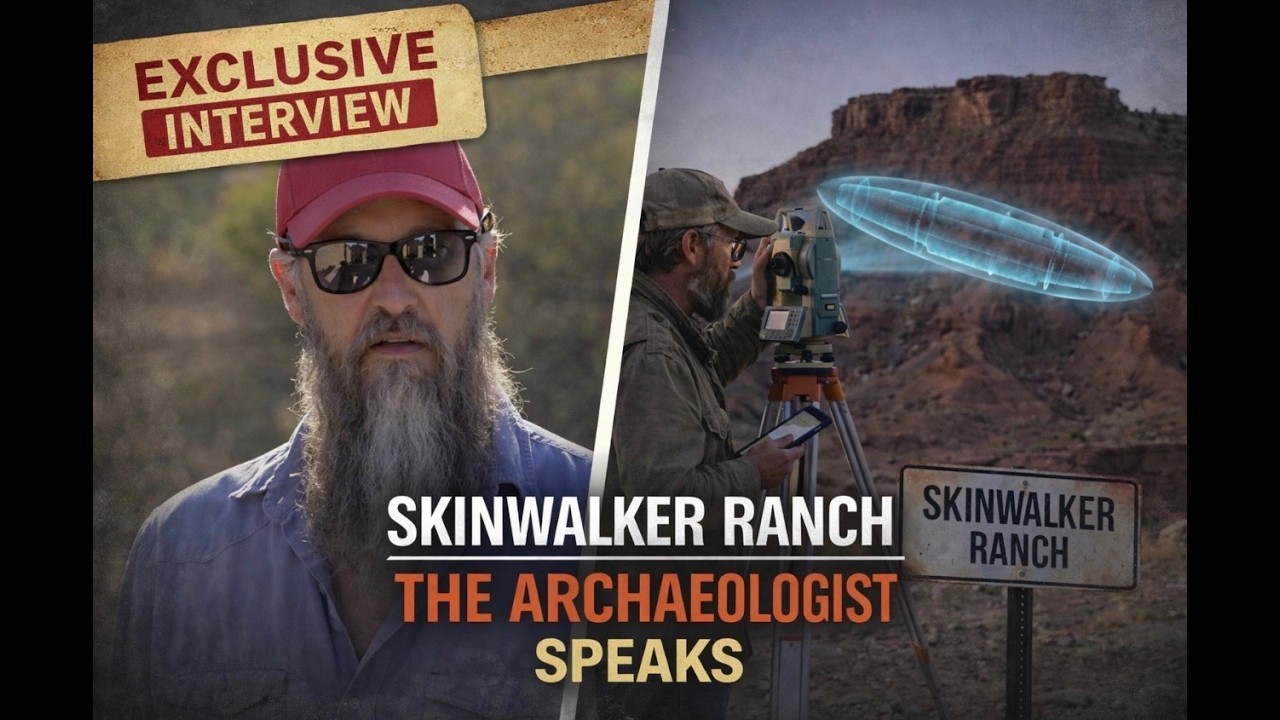
From Archaeologist to Skinwalker Ranch: Unearthing the Mystery Beneath the Mesa
A Chance Encounter That Changed Everything
For most of his career, archaeologist Thomas Winterton’s colleague and field researcher—known to audiences through The Secret of Skinwalker Ranch—followed a straightforward mission: protect and document the past. Trained in archaeology and environmental resource management, he spent years surveying sites across the American West, preserving cultural resources before development projects could disturb them.
He never intended to become a television personality or a participant in one of the most controversial investigations in modern paranormal research.
His journey to Skinwalker Ranch began unexpectedly in 2021 during a visit to a secondhand store in Fort Duchesne, Utah. While helping his wife load furniture, he struck up a conversation with ranch caretakers Thomas Winterton and Candus Winterton. What started as a discussion about music quickly evolved into a conversation about archaeology, history, and the mysterious property they managed.
At the time, he had already read the book Hunt for the Skinwalker years earlier but had largely forgotten about it. Within months, informal discussions turned into invitations to visit the ranch and eventually into a long-term archaeological survey project.




What followed would fundamentally reshape his understanding of both archaeology and the unknown.
Protecting the Past on Private Land
Unlike many archaeological projects tied to construction or environmental compliance, Skinwalker Ranch presented a rare opportunity.
The ranch’s owners wanted a comprehensive inventory of archaeological resources across the property—not because regulations required it, but because they wanted to understand and preserve its history.
For an archaeologist, that opportunity was unusual.
Over the next several years, extensive surveys documented prehistoric and historic sites across the ranch. The work focused on identifying cultural resources, mapping sensitive areas, and ensuring that future investigations would not inadvertently damage significant archaeological remains.
What emerged was a picture of remarkable historical depth.
According to the archaeological evidence, portions of the ranch show signs of repeated human occupation spanning thousands of years. While not continuously inhabited, certain locations appear to have attracted people from multiple cultures across vastly different periods.
That pattern stood out.
The ranch is not considered prime real estate by traditional archaeological standards. Although water sources exist nearby, there are many locations throughout the region that would appear more practical for settlement.
Yet people repeatedly returned to this place.
For an archaeologist accustomed to explaining sites through environmental factors, hunting opportunities, or resource availability, the pattern raises intriguing questions.
Why here?
A Landscape Occupied for Millennia
One of the most significant archaeological observations concerns the longevity of human activity in the area.
Many archaeological sites represent a single period of use—a hunting camp, a seasonal settlement, or a temporary resource-processing location. Skinwalker Ranch appears different.
Evidence suggests that people from different cultural periods repeatedly occupied the same locations over thousands of years.
To archaeologists, that kind of recurring use often indicates that a site held particular significance.
The exact reason remains unclear.
It may have been ceremonial, spiritual, environmental, or related to factors no longer visible in the archaeological record. What is clear is that generations of people were drawn to the same landscape long before modern stories about UFOs, portals, or unexplained phenomena emerged.
This observation extends beyond Skinwalker Ranch itself.
Researchers have noted similar patterns at locations such as Mount Wilson Ranch, often described as a “sister site” to Skinwalker Ranch due to its history of anomalous reports and previous ownership connections.
Both locations exhibit strong archaeological evidence of long-term Indigenous presence, suggesting that whatever attracted modern investigators may have been attracting people for thousands of years.
The Mystery Inside the Mesa
The most dramatic developments came during investigations of the ranch’s famous mesa.
For years, scientific instruments detected unusual anomalies within the rock formation. Ground scans suggested disturbances beneath the surface, but researchers could not determine their source.
To investigate, drilling operations extracted material from deep within the mesa.
The expectation was simple: sediment, rock fragments, and naturally occurring geological material.
Instead, researchers encountered something unexpected.
Among the recovered materials were metallic fragments, unusual green gelatinous substances, ceramic-like pieces, and even a 1964 nickel.
For an archaeologist trained to classify artifacts into known categories, these discoveries presented an unusual challenge.
Normally, every object fits somewhere within an established framework. Ceramics can be identified. Metals can be classified. Manufacturing techniques can be traced.
Some of the recovered materials resisted easy classification.
The ceramic fragments, in particular, drew attention after laboratory examinations reportedly suggested unusual properties. According to the researcher, preliminary analyses indicated behavior that appeared inconsistent with conventional historical ceramics, leading to further testing and ongoing study.
Likewise, certain metallic fragments displayed characteristics that investigators found difficult to explain using standard archaeological comparisons.
While conclusions remain tentative and additional research continues, the discoveries transformed the investigation from one focused on geophysical anomalies into one involving tangible physical evidence.
As the archaeologist put it, the boreholes were intended to avoid the anomaly—not strike it.
Yet material evidence emerged anyway.
The Nickel That Shouldn’t Have Been There
Among all the strange finds, one of the simplest objects generated significant discussion: a 1964 nickel.
To a casual observer, the coin may seem insignificant. To an archaeologist, however, it functions as a chronological marker.
The presence of a 1964 nickel means that whatever process placed it within the mesa could not have occurred before that year.
The coin itself is not rare. In fact, 1964 nickels were produced in enormous quantities.
What matters is context.
The nickel reportedly exhibited weathering and patina consistent with long-term burial rather than recent loss. If it genuinely originated from within the mesa deposits, it suggests that some form of disturbance occurred after 1964.
Whether that disturbance was natural, human-made, or something else remains unknown.
The coin does not solve the mystery.
It merely establishes a date.
For archaeologists, that alone can be valuable.
Indigenous Traditions and the Search for Context
As the investigation deepened, the researcher found himself revisiting historical and ethnographic sources related to Indigenous traditions throughout the American Southwest.
He emphasizes that archaeology deals primarily with material evidence rather than folklore. Nevertheless, the historical record contains extensive accounts of spiritual practices, ceremonial sites, and beliefs involving transformation, shapeshifting, and supernatural forces.
During earlier fieldwork on tribal lands, he once documented an iron axe head wrapped in deer hide resting on an isolated sandstone ledge. At the time, it seemed merely unusual.
Years later, after studying ethnographic records associated with Navajo spiritual traditions, he realized that iron and deer hide have appeared in descriptions of ritual practices and ceremonial magic.
The object suddenly took on new significance.
Whether it represented an offering, ceremonial activity, or something else remains impossible to determine with certainty. Yet it illustrates how archaeological discoveries sometimes acquire new meaning as historical understanding evolves.
For him, these experiences highlight an important point: not every significant archaeological site can be explained solely through practical concerns such as food, water, or shelter.
Some places appear to have mattered for reasons that are harder to measure.
Beyond the Ranch
The researcher’s work eventually expanded beyond Skinwalker Ranch itself.
At Mount Wilson Ranch, he documented museum-quality projectile points, ceremonial artifacts, and evidence suggesting long-term occupation and ritual activity.
The site has generated its own collection of paranormal reports over the years and was previously investigated by researchers associated with Skinwalker Ranch.
Unlike Skinwalker Ranch, Mount Wilson welcomes public visitors, allowing people to explore portions of the property and engage directly with its history.
For the archaeologist, both locations raise similar questions.
Why were people repeatedly drawn there?
What significance did these places hold across centuries—or even millennia?
And are modern reports of unusual phenomena somehow connected to the same factors that attracted ancient populations?
Those questions remain unanswered.
A Life Changed by the Search
When asked how the experience has affected him personally, the archaeologist admits that the investigation changed his perspective.
He entered the project as a scientist focused on artifacts, sites, and evidence.
He remains committed to those principles.
Yet years of work at the ranch have convinced him that there is still much humanity does not understand.
The most profound realization, he says, is not necessarily that extraordinary phenomena exist, but that the search itself may be larger than any single explanation.
Scientists, historians, archaeologists, engineers, and investigators are all approaching the mystery from different directions.
Each contributes a piece of the puzzle.
For him, the ultimate goal remains clear: gain access to the interior of the mesa and carefully excavate whatever lies within.
Only then, he believes, will researchers have a chance to understand what generated the anomalies, produced the unusual materials, and inspired thousands of years of human attention.
Until that day arrives, the mystery remains buried beneath the sandstone.
And for an archaeologist dedicated to uncovering the past, that unanswered question may be the most compelling artifact of all.