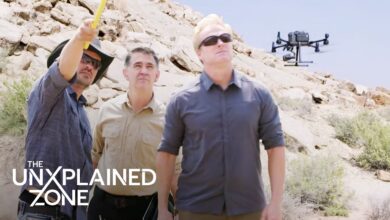
The TRAGIC Truth About The Skinwalker Ranch Cast Nobody Talks About…
The TRAGIC Truth About The Skinwalker Ranch Cast Nobody Talks About...

Dragon avoided interviews.
For months after the cabin was sealed, he refused every request to discuss what had happened. Researchers, journalists, and even members of the ranch team tried to get answers, but his responses never changed. He would simply shake his head and say, “You wouldn’t understand it if I explained it.”
At first, people assumed the experience had traumatized him. That was the simplest explanation. But those closest to him noticed something stranger.
Dragon never claimed that anything attacked him.




He never described monsters, apparitions, or shadowy figures lurking in the darkness.
Instead, he spoke about patterns.
He said the cabin seemed to anticipate his actions before he made them. Objects would be exactly where he expected them to be before he consciously remembered placing them there. Thoughts would enter his mind moments before events occurred, as though the sequence of cause and effect had become blurred.
One evening, during a private conversation that was never intended for public release, he reportedly made a statement that left everyone in the room silent.
“I don’t think it was trying to hurt me,” he said.
“I think it was trying to understand what it means to be human.”
The remark was dismissed at the time as stress-induced speculation.
Years later, some investigators weren’t so sure.
When the final analysis of the cabin was completed, a disturbing detail emerged.
The electromagnetic grounding plates beneath the floor weren’t arranged randomly.
When mapped together, they formed a geometric pattern resembling a neural network.
Not a circuit.
Not a power grid.
A model of interconnected pathways similar to those found in the human brain.
The discovery raised uncomfortable questions.
Why would a remote structure on an isolated ranch contain a layout that mirrored cognitive architecture?
And why did the environmental responses appear strongest during moments of intense emotional activity?
Fear.
Confusion.
Curiosity.
The system seemed to react most aggressively when human consciousness became unstable.
One analyst proposed a theory so controversial that it was omitted from the official report.
According to his interpretation, the cabin was never designed to observe physical phenomena.
It was designed to observe perception itself.
The subject was never the ranch.
The subject was the observer.
Then came the final anomaly.
Months after the site was closed, a maintenance team returned to inspect the structure before permanent decommissioning.
The cabin had remained locked.
No one had entered.
No power had been connected.
No equipment remained inside.
Yet when the door was opened, investigators discovered a single object resting in the center of the floor.
A notebook.
Brand new.
Dry despite recent storms.
The first several pages were blank.
The rest contained handwritten entries.
The writing did not match Dragon’s.
It did not match any known member of the research team.
There were no fingerprints.
No DNA.
No indication of how it arrived there.
Most of the entries were short observations.
Descriptions of human behavior.
Emotional reactions.
Patterns of speech.
Fragments of memories.
They read less like journal entries and more like field notes written by an outside observer studying people.
The final page contained only one sentence.
“Observation phase complete.”
Nothing else.
No signature.
No explanation.
The notebook disappeared shortly after being cataloged.
Officially, it was misplaced during evidence transfer.
Unofficially, no one seems willing to discuss it.
The cabin itself was eventually sealed.
Its entrances reinforced.
Its coordinates quietly removed from operational maps.
To this day, visitors to that section of the ranch report nothing unusual.
No lights.
No sounds.
No visible anomalies.
Just an aging structure slowly being reclaimed by the desert.
But among those familiar with the story, one detail continues to circulate.
The last thermal scan conducted before the shutdown revealed a faint heat signature inside the cabin.
Not human.
Not animal.
Not mechanical.
It appeared only for a few seconds.
Long enough to register.
Long enough to be recorded.
And then it vanished.
The official conclusion was inconclusive.
No evidence of intrusion.
No identifiable source.
Case closed.
Yet for some investigators, the question never went away.
If the cabin truly functioned as an observation chamber, and if something had been studying the people who entered it…
What happened when the study ended?
Did the observer leave?
Or did it simply learn enough that it no longer needed the cabin at all?
No one knows.
And perhaps that uncertainty is the most unsettling part of the story.
Because mysteries are frightening when they remain unsolved.
But they can be far more frightening when they might already have found their answer.