The Sacred Symbol That Changes Everything on Oak Island
The Sacred Symbol That Changes Everything on Oak Island
The Sacred Symbol That Could Rewrite Oak Island History
A 260-Year-Old Map, a Roman Relic, and a Templar Fortress: The Mystery Deepens
For more than two centuries, Oak Island has remained one of the world’s most enduring mysteries. Countless theories have attempted to explain the strange structures, artifacts, and anomalies discovered on the small island off the coast of Nova Scotia. Yet a symbol found on a 260-year-old map may now be connecting some of the most compelling pieces of evidence ever uncovered.
What began as a small marking on an eighteenth-century survey has evolved into a theory linking Oak Island to medieval Portugal, the Knights Templar, and even one of Christianity’s most sacred relics.
The Symbol on the Morris Map
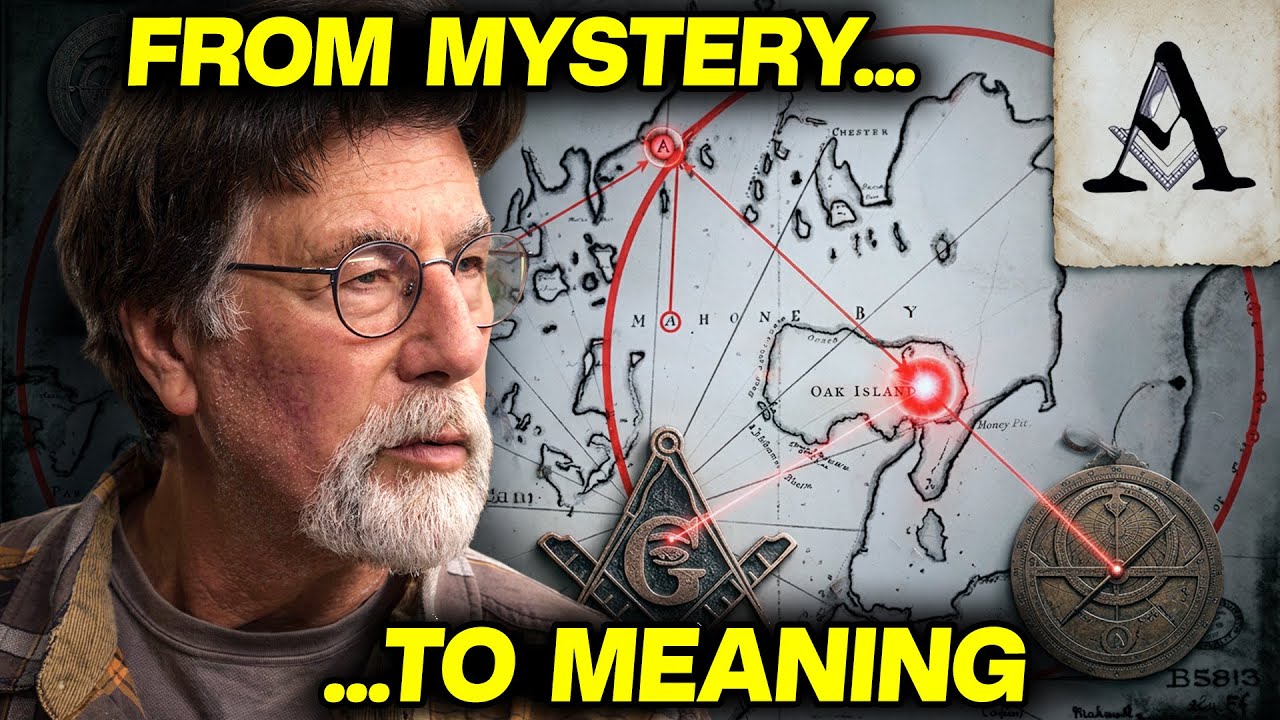
The discovery was presented during Season 13 of The Curse of Oak Island by researcher Scott Clark, a 32nd-degree Mason and author of Oak Island Odyssey: A Masonic Quest. His presentation, titled From Nazareth to Nova Scotia, focused on an unusual symbol found on Charles Morris’s 1762 survey map of Mahone Bay.
Morris was a British colonial surveyor whose maps served practical administrative purposes. They documented coastlines, harbors, navigation routes, and property boundaries—not hidden treasure.




Yet Clark identified something unusual: a stylized letter “A” featuring a distinctive V-shaped crossbar. While most historians might dismiss it as a surveyor’s notation or cartographic shorthand, Clark noticed that the directional line implied by the symbol pointed directly toward Oak Island.
On its own, the observation might have remained an interesting curiosity. Instead, it became the starting point of a far more ambitious investigation.
From Nova Scotia to Rome
Clark traced the same distinctive symbol to the Titulus Crucis, a wooden tablet preserved in Rome’s Basilica of the Holy Cross in Jerusalem. According to Christian tradition, this inscription was placed above Jesus Christ during the Crucifixion.
Among the tablet’s inscriptions appears a remarkably similar letter form—the same stylized “A” with the unusual V-shaped crossbar.
The resemblance alone does not prove a connection. Symbols often recur across cultures and centuries. Nevertheless, the similarity was striking enough to encourage further investigation.
The Portuguese Templar Connection
Clark’s research then moved to Portugal, specifically the Convent of Christ in Tomar.
The significance of Tomar cannot be overstated. Following the suppression of the Knights Templar by Pope Clement V in 1312, most Templars throughout Europe were arrested, executed, or absorbed into other religious orders. Portugal was the notable exception.
There, the Templars effectively survived by transforming into the Order of Christ, inheriting the Templars’ assets, properties, and maritime ambitions. This organization later became a driving force behind Portugal’s Age of Exploration.
At Tomar, researcher Corjan Mol documented A-shaped carvings displaying the same distinctive characteristics identified by Clark on the Morris map. Similar forms also appear on Portuguese Templar gravestones and pentacles, suggesting a symbolic tradition that may have endured for centuries.
Clark’s ultimate conclusion was bold: a fragment of the True Cross may have been transported across the Atlantic by members of the Order of Christ and concealed on Oak Island.
Such a claim would require extraordinary evidence. Yet what made Clark’s theory difficult to dismiss was not the symbol itself—it was the growing body of independent evidence emerging from elsewhere on the island.
The Stars Point to the Same Era
While Clark examined historical symbols, archaeoastronomer Professor Adriano Gaspani was studying Oak Island from an entirely different perspective.
Using a method based on axial precession—the slow shift of Earth’s rotational axis over time—Gaspani analyzed alignments between Oak Island’s structures and specific stars.
His investigation focused on several mysterious features:
- The octagonal wooden stakes found in the swamp.
- Nolan’s Cross, the massive stone formation discovered by Fred Nolan.
- The stone triangle.
- The Lot 15 stone cairn.
Gaspani determined that these structures align with the setting position of Deneb, the brightest star in the constellation Cygnus. Based on precession calculations, he dated the alignments to a construction period between approximately 1200 and 1300 AD.
That timeline is extraordinary.
It predates the earliest confirmed European settlements in Nova Scotia by roughly three centuries.
Even more intriguing, Gaspani compared Oak Island’s alignments to those found at Enzano Castle in northern Italy, a historically documented Templar property. Both sites displayed remarkably similar relationships to the stars Deneb and Arcturus.
Two locations separated by thousands of miles appeared to share the same astronomical framework and the same medieval timeframe.
A Medieval Network Across the Atlantic?
Researcher Charlotte Wheatley expanded the investigation further.
She identified three medieval churches near Talmont-sur-Gironde in southwestern France that align geographically with Oak Island. Gaspani subsequently confirmed that these churches and Oak Island’s Lot 5 circular feature share references to stars including Sirius, the Pleiades, and Hamal.
His dating placed the Lot 5 structure around 1236 AD.
Once again, the evidence pointed toward the same narrow medieval window.
While these findings do not prove Templar involvement, they suggest that whoever designed these features possessed astronomical knowledge consistent with medieval European traditions.
What the Ground Revealed
The archaeological evidence proved equally provocative.
Leather from the Twelfth Century
Carbon-14 testing of leather shoe fragments recovered from Oak Island’s swamp produced a date range between 1148 and 1216 AD.
If accurate, these artifacts belong to the era of the Crusades and the earliest years of the Knights Templar.
There is currently no conventional historical explanation for European-style worked leather appearing on a Nova Scotia island during the twelfth century.
The Lot 8 Stone Structure
Beneath a large boulder on Lot 8, researchers uncovered a man-made stone cradle held together by three distinct mortar compositions.
The presence of multiple mortars suggests prolonged construction activity or builders drawing materials from different sources.
Dating indicates a construction period beginning after the thirteenth century and ending before the eighteenth century.
Even more significant were soil samples showing lead concentrations eleven times higher than the island average. Combined with layers of ash and coal, the evidence suggests metallurgical activity occurred at the site.
In other words, someone may have been building and processing metal on Oak Island long before recorded colonial settlement.
The Portuguese Cannonballs
Among the most fascinating discoveries were stone cannonballs carved from olivine gabbro and olivine basalt.
These volcanic rocks do not occur naturally in Nova Scotia.
Geological analysis traced the material to the Azores, Portugal’s volcanic archipelago in the Atlantic Ocean.
Archaeological experts dated the cannonball style to the fourteenth and fifteenth centuries, while Portuguese military specialists confirmed that their dimensions matched ship-mounted artillery of the same period.
CT scans revealed deliberate tool marks associated with medieval stoneworking techniques.
Taken together, the evidence strongly suggests a Portuguese maritime connection.
A Pattern Too Consistent to Ignore
What makes the Season 13 discoveries remarkable is not any single piece of evidence.
One anomaly can be dismissed.
Two demand attention.
But multiple independent disciplines all converging on the same centuries is far harder to explain away.
Consider the evidence:
- Carbon dating places leather artifacts in the twelfth century.
- Astronomical alignments point to construction between 1200 and 1300 AD.
- Mortar and structural analysis indicate medieval building activity.
- Volcanic stone cannonballs connect Oak Island to Portuguese maritime technology of the fourteenth and fifteenth centuries.
Each conclusion was reached by different experts using different methodologies.
Yet all point toward the same medieval timeframe.
Why the Sacred Symbol Matters
By itself, the symbol on the Morris map proves nothing.
The resemblance between a map marking, a Roman relic inscription, and Portuguese carvings could simply be coincidence. Human beings are naturally inclined to recognize patterns, even where none exist.
Indeed, the connection to the True Cross remains the most speculative element of Clark’s theory.
However, the symbol gains significance when viewed alongside the broader body of evidence.
The map points to Oak Island.
The astronomical data points to the medieval era.
The cannonballs point to Portugal.
The artifacts point to sustained activity centuries before conventional history says anyone should have been there.
Clark’s symbol does not prove that the Knights Templar reached Oak Island. Nor does it prove that a sacred relic was hidden there.
What it does provide is another independent line of evidence connecting Oak Island to the same Portuguese-Templar network suggested by archaeology, geology, and archaeoastronomy.
The sacred symbol on Charles Morris’s 1762 map may never be accepted as definitive proof of anything. Yet it arrives at a moment when multiple strands of evidence are converging on the same conclusion: something significant occurred on Oak Island during the medieval period.
The symbol links Nova Scotia to Rome, Tomar, and a historical timeline stretching back to the age of the Crusades. It strengthens a pattern already emerging from the ground, the stars, and the artifacts themselves.
Whether that pattern ultimately leads to the Knights Templar remains uncertain.
But with each new discovery, the medieval window surrounding Oak Island becomes increasingly difficult to ignore.
And if that window continues to narrow, historians may eventually be forced to reconsider one of the most intriguing possibilities in North American history—that centuries before official exploration, someone crossed the Atlantic, built on Oak Island, and left behind clues that are only now beginning to be understood.