SCIENTISTS Opened a Tunnel Beneath Skinwalker Ranch — What They Found Changed Everything
SCIENTISTS Opened a Tunnel Beneath Skinwalker Ranch — What They Found Changed Everything
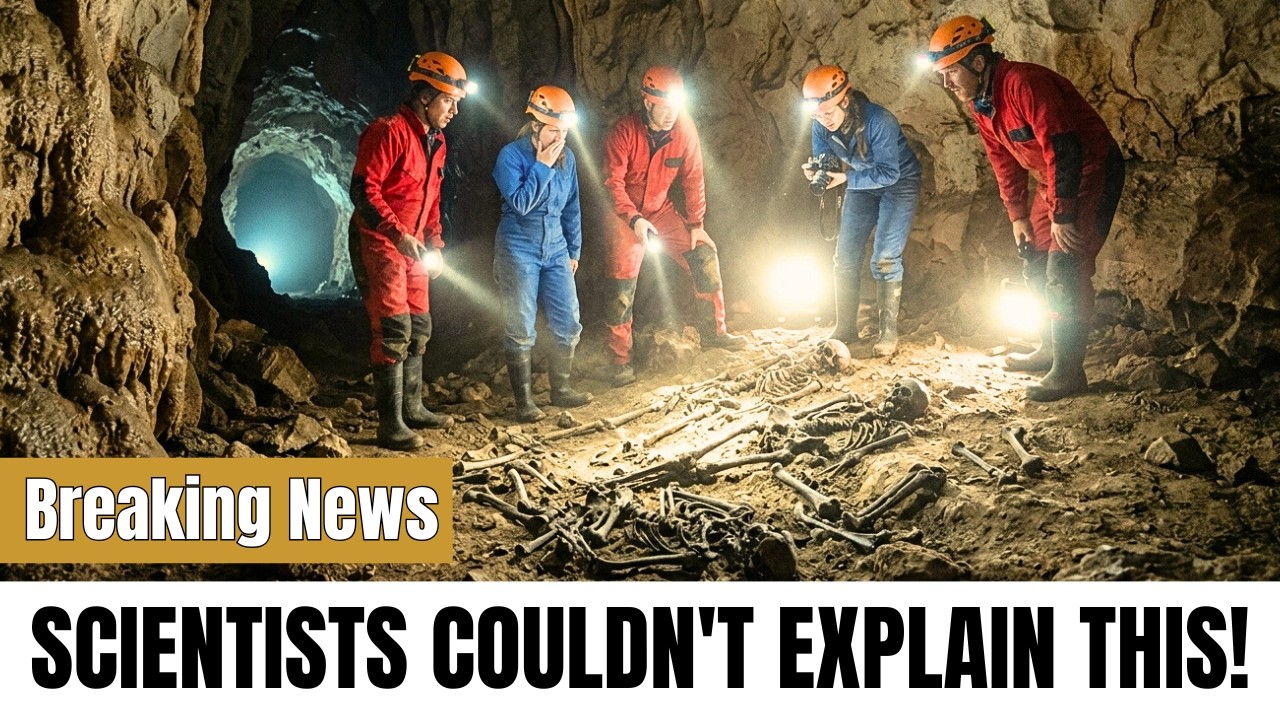
A team of credentialed scientists stood at the mouth of a hole in the ground and realized, almost without saying it out loud, that they had crossed a line the data had been pointing toward for years.
Not ghost-hunters. Not performers. Researchers with calibration logs, redundant sensors, and the kind of caution that usually smooths strange readings into something ordinary. But here, nothing was smoothing out. Everything was sharpening.
The tunnel beneath Skinwalker Ranch wasn’t supposed to change the story. It was supposed to extend it—another measurement point, another controlled descent into uncertainty. That’s how it started. Surface surveys had already been abnormal for years: electromagnetic fields that refused to stabilize, radiation that rose in pockets with no source, and UAP trajectories that seemed to favor the ground more than the sky. The pattern had always been there, just never accessible.
Until the radar finally stopped pretending it was noise.



Ground-penetrating scans showed a structure where no structure should exist—too coherent to be collapse, too organized to be erosion. When the team followed that signature to the surface, they didn’t find debris or fracture lines. They found an opening. Half-hidden, half-collapsed, but unmistakably deliberate in its geometry, like something that had been waiting to be noticed rather than discovered.
And from the moment they approached it, the instruments began to disagree with reality.
Inside the tunnel, the first few steps were deceptively normal. That’s what made the shift so disorienting. Baseline readings held. Radios stayed clean. Even the air, at first, behaved like air.
Then the environment started responding.
Electromagnetic fields climbed in steady, structured increments—not spikes, not interference, but a controlled rise that suggested directionality. Radiation didn’t scatter randomly; it concentrated along a vector deeper inside the passage, as if something was being indicated rather than emitted. Multiple independent systems—thermal, EM, dosimetry—began to converge on the same invisible point in space.
And that was the moment the science stopped feeling like observation and started feeling like participation.
Because coincidence doesn’t synchronize instruments. And it definitely doesn’t synchronize them across unrelated measurement types.
The deeper they went, the more the tunnel behaved like a system under pressure rather than an inert cavity. The geometry itself became harder to classify. Straight sections where nature prefers curves. Angles that suggested intention rather than erosion. Surfaces that didn’t quite match known geological formation processes, not because they were impossible individually, but because they were organized.
That’s what unsettled the scientists more than any single reading: structure.
Nature is noisy. This wasn’t.
At one point, without warning or instruction, the pattern inside the data changed again. Not in magnitude, but in relationship. EM fluctuations and subsurface vibration signatures stopped behaving like separate phenomena. They began moving together—correlated, synchronized, as if driven by the same underlying mechanism. Not metaphorically linked. Mathematically linked.
And once that connection appeared, it couldn’t be unseen.
Whatever was happening underground wasn’t isolated processes layered on top of each other. It looked like a coupled system—different expressions of a single source behaving in real time.
No one on camera said “we’ve found it.” They didn’t need to. The silence carried more weight than the instruments.
Because at that point, the question stopped being whether something unusual was present beneath the ranch.
It became whether the team had just entered its operating range.
There was a moment—quiet, almost easily missed in the footage—where one of the researchers paused. Not because a device failed. Not because an alarm triggered. They simply stopped, turned toward a section of wall, and stayed still long enough for the rest of the team to notice something was wrong without needing to be told.
No reading explained it. No display justified it. But something in the environment had registered, at human level first, instrument level second.
That reversal matters. On a site like this, instruments are supposed to lead perception. Here, perception reacted first.
The implication lingered longer than any data spike.
As the team continued mapping, ground-penetrating radar revealed something even more difficult to dismiss: the tunnel was not an endpoint. It connected to additional voids—spaces beyond the explored boundary that suggested continuity rather than termination. The system extended further than the investigation could safely verify.
That’s where interpretation fractures.
Because at that stage, three explanations remain on the table, and none of them comfortably resolve the data.
It could be natural geology, rare and poorly understood, but still within Earth’s capacity. It could be ancient human construction, lost to time, with engineering sophistication we don’t yet have context for. Or it could be something that doesn’t fit either category cleanly—something that treats the underground not as space, but as medium.
The instruments don’t choose between those options. They only report that whatever is beneath the ranch behaves consistently, coherently, and in relation to surface activity above it.
Which brings the uncomfortable part into focus.
If surface anomalies have always been “symptoms,” then the tunnel didn’t create a discovery—it confirmed a direction. Downward. Deeper. Toward something that was never visible from the surface because it was never meant to be seen that way.
And once that idea enters the dataset, it changes how every previous season reads.
Because now the ranch isn’t just a location where strange things happen.
It’s a layered environment where those things appear to originate from below observation level.
Nothing about that conclusion is final. The scientists don’t treat it as one. They can’t. The data isn’t complete, and the structure hasn’t been fully mapped.
But science doesn’t require certainty to reach pressure points. It only requires consistency across independent measurements. And here, consistency is exactly what refuses to go away.
So the investigation continues, but differently now.
Not outward into the sky.
Not laterally across the surface.
Downward, into a system that behaves less like terrain and more like a coordinated response to being measured.
And that leaves the central question exactly where it should be left at this stage:
If the ground beneath Skinwalker Ranch is not just ground, what exactly has the team been standing on all along—and what happens when observation finally reaches whatever has been reflecting it back?