Vanessa Lucido Finally Reveals Oak Island Treasure Discovery!
Vanessa Lucido Finally Reveals Oak Island Treasure Discovery!
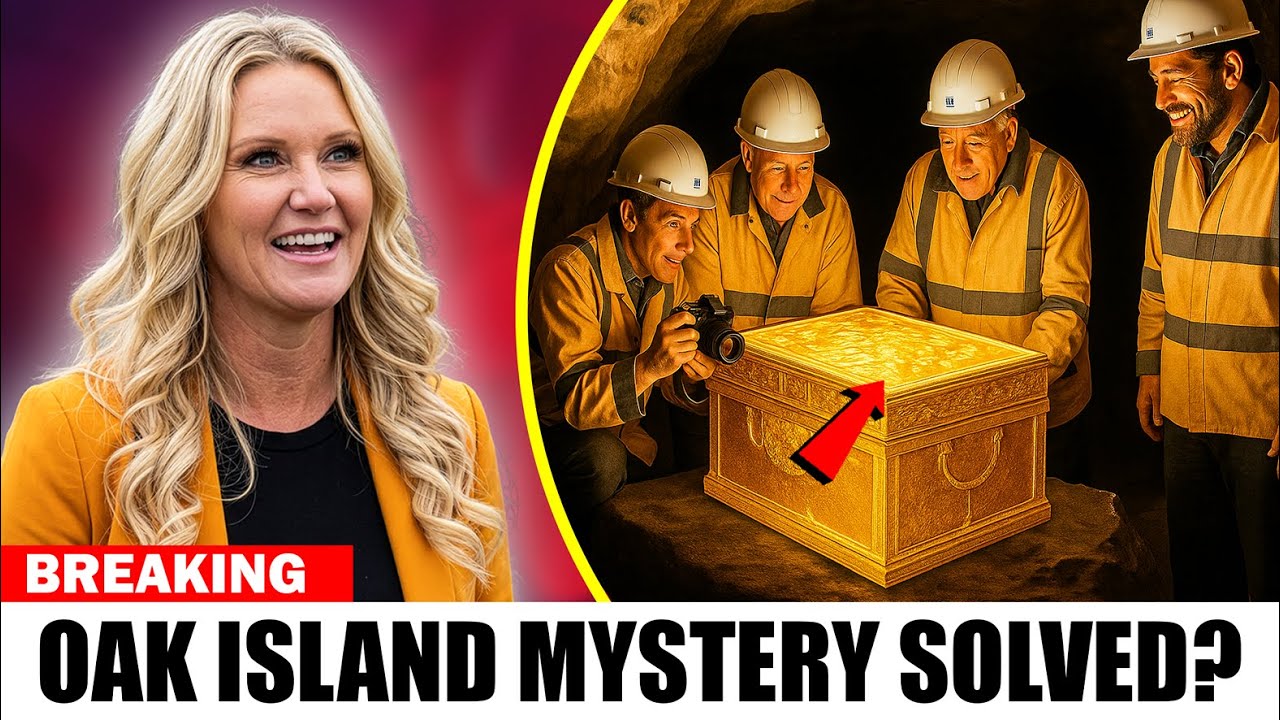
In 1897, something was buried beneath Oak Island.
Not in a vault.
Not in a museum.
But deep underground, where it was meant to stay hidden.
For more than a century, no one knew it existed.
No records.
No signatures.
Only silence.
That silence was finally broken when Vanessa Lucido announced that the Oak Island treasure had been found.
But what makes this discovery different is not the value of what was uncovered.
It’s why it was hidden in the first place—
and who never wanted it to be found.
For generations, Oak Island has been linked to pirate gold, lost fortunes, and legendary myths.
But what if the real treasure was never gold at all?
What if it was a truth buried so deeply that history itself tried to forget it?




Before we go any further and discover what’s hidden below,
don’t forget to subscribe to the channel.
Because some discoveries don’t just reveal treasure—
they rewrite history.
The day the oscillator hit the impossible
The ground on Oak Island does not give up its secrets easily.
For over a decade, the team has drilled, dug, and blasted.
But the island always seemed to have a counter move.
That changed this week.
Vanessa Lucido, head of ROC Equipment, stood next to the massive oscillating rig,
her eyes fixed on the monitors.
This machine is not your average construction tool.
It is a towering giant of steel and hydraulics,
designed to grind a steel casing deeper into the earth than ever before.
It was loud—
the kind of mechanical roar you can feel in your chest from 50 feet away.
But then the sound changed.
It went from a grinding roar to a sudden, shuddering halt.
The oscillator had hit something hard.
Hitting rocks is common on Oak Island.
Glaciers left millions of them behind thousands of years ago.
But this was different.
The depth was exactly 150 feet—
the precise level where the legendary Chappell Vault is supposed to be.
Vanessa signaled the operator to hold.
The tension in the air was thick enough to cut with a knife.
Basically, everyone stopped breathing.
The team gathered around the spoils pile—
the mound of wet gray clay brought up by the hammer grab.
They were looking for blue clay,
the telltale sign of the original Money Pit.
But what they found was far more shocking.
Mixed in with the muck were shards of hand-hewn timber.
Not old roots—
wood that had been cut by an axe.
And that’s putting it lightly.
Finding wood is one thing.
Finding wood that smells ancient is another.
The team rushed it to the lab.
The carbon-dating results were the kind of numbers that make you sit down.
Fourteen hundred.
That is not a typo.
The wood dates back to a time before Columbus sailed the ocean blue.
This means someone was digging deep underground on this tiny island
centuries before the first settler ever set foot in Nova Scotia.
Vanessa confirmed the casing on the giant steel tube was perfectly vertical.
They had not drifted.
They were dead center over the anomaly.
Then came the water.
As the oscillator churned the earth,
water began bubbling up inside the casing.
Usually, this is a bad sign.
It means the flood tunnels are working.
But this time, the water brought a message.
It was murky,
filled with particulate matter that sparkled under the harsh work lights.
When the hammer grab came up,
it wasn’t just holding mud.
It was holding the answer to a riddle that has baffled searchers for 220 years.
The teeth of the grab were scratched.
Deep gouges in hardened steel proved it had engaged with something incredibly dense.
It wasn’t granite.
It was metal.
And judging by the way the machine groaned,
it was a massive amount of metal.
Just as they believed the treasure was within reach,
the island revealed its deadliest move yet.
When science confirms the legend
Dr. Ian Spooner has been analyzing borehole water for years,
using a cutting-edge method known as hydrogeochemistry.
In simple terms,
groundwater flows beneath the earth like a slow-moving river.
When it passes through gold deposits,
it absorbs microscopic flecks of the metal.
By testing this water,
scientists can determine whether gold is nearby.
But these results weren’t minor traces.
They were massive.
Concentrations so extreme
they simply do not occur naturally.
It was as if the water had been trapped inside a chamber
lined with gold coins for 300 years.
The data revealed zinc, copper, silver, and gold—
the precise fingerprint of a buried treasure cache.
Zinc and copper point to brass or bronze containers.
Silver and gold need no explanation.
Finding these readings at the exact depth of the Chappell Vault
is the ultimate smoking gun.
The vault was first struck in the 1890s.
When the drill surfaced,
it carried flakes of gold—
but the shaft collapsed before they could reach it again.
Now, Vanessa has reinforced that exact location with steel.
But the science gets even stranger.
Muon topography—
think of it as an X-ray for the planet.
Sensors placed in boreholes detect cosmic rays.
Dense material blocks them.
Empty spaces allow them through.
The scans revealed a low-density cavern—
a man-made chamber.
Inside that chamber,
density spikes again,
pointing to a massive metallic object.
Gold is one of the heaviest elements on Earth.
In large quantities,
it bends data in unmistakable ways.
The readings match known mother lodes.
But this isn’t scattered across the seafloor.
It’s neatly stacked in a box
150 feet below ground.
The evidence is overwhelming.
The treasure is no longer legend.
But knowing where it is
is very different from retrieving it.
The curse that demands a seventh soul
The tragedy began in 1795
with three boys and a strange depression in the ground.
Layers of logs appeared at 10 feet,
20 feet,
30 feet.
At 90 feet, a stone tablet.
Then the flood.
The legend claims seven must die
before the island gives up its secret.
Six already have.
Vanessa knows the history—
the Restall tragedy,
toxic gases,
exploding boilers,
collapsed cranes.
The island resists.
Five finger drains from the ocean,
packed with coconut fiber and eel grass—
a hydraulic trap built centuries ago.
Every attempt failed.
Until now.
Vanessa had what others didn’t:
precision
and the oscillator.
Who put it there?
Carbon dating rules out pirates.
The timeline points elsewhere.
The Knights Templar.
Disbanded in 1307.
Their fleet vanished overnight.
Some believe they crossed the Atlantic,
hiding their wealth beyond reach.
Others believe the treasure is not gold—
but the Ark of the Covenant.
Or sacred relics from Solomon’s Temple.
There are theories of Shakespeare manuscripts,
mercury preservation,
star maps,
and celestial alignments.
Not treasure—
a monument.
The final descent
The casing is in place.
The vault is located.
But one wrong move could destroy everything.
A diver?
A freeze ring?
Liquid nitrogen.
Solid ice.
Careful excavation.
The skeptics are silent.
Hand-cut timber from the 1400s.
Massive metal.
Gold in the water.
Vanessa Lucido and her team have done the impossible.
So now the question is yours:
Should they send a diver down,
or is it too dangerous?
Hit like if you want to see the gold.
Subscribe so you don’t miss the moment
history is finally unearthed.