How the Chicago Bears Will Replace 150 MISSING Targets from DJ Moore & Olamide Zaccheaus
How the Chicago Bears Will Replace 150 MISSING Targets from DJ Moore & Olamide Zaccheaus
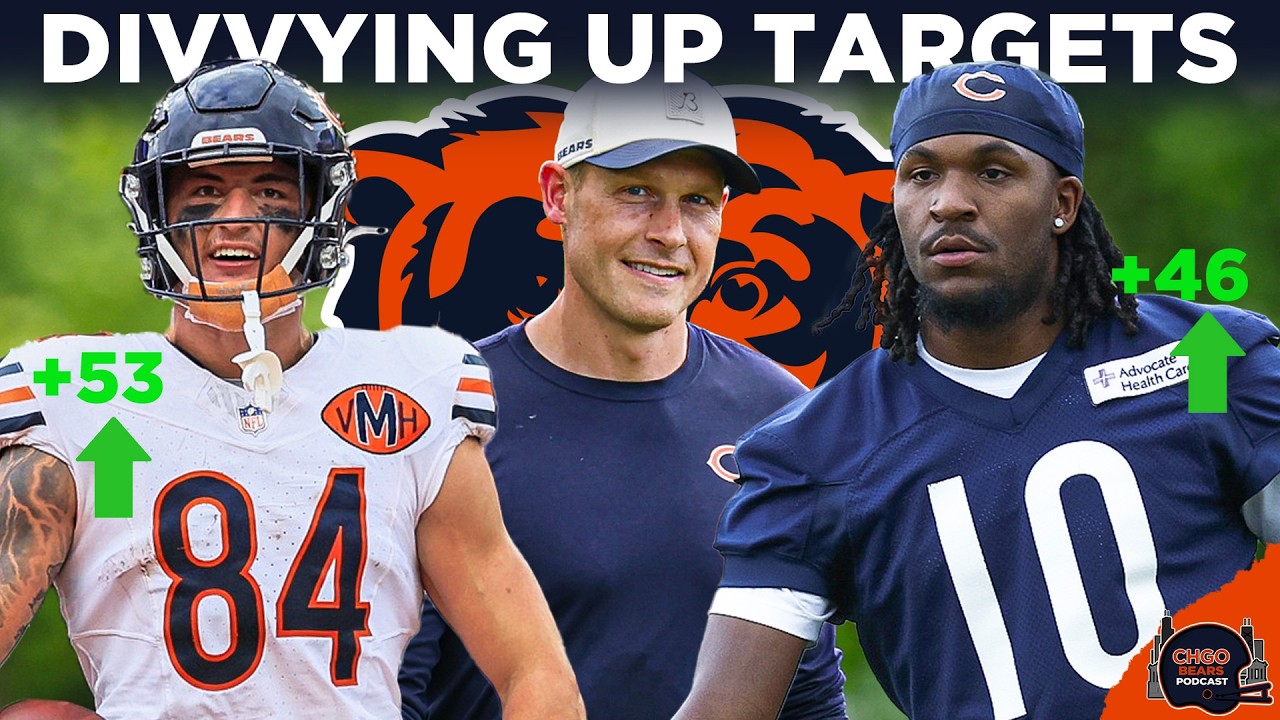
Who Replaces 150 Missing Targets? Breaking Down the Chicago Bears’ New Offensive Distribution for 2026
One of the biggest questions facing the Chicago Bears entering the 2026 season isn’t who will start at quarterback or how the offensive line will perform. It’s much simpler—and potentially far more important.
Who will absorb the 150 targets left behind by the departures of DJ Moore and Equanimeous St. Brown?
With a revamped offense, an emerging franchise quarterback in Caleb Williams, and several young playmakers poised for larger roles, Chicago has no shortage of candidates. The challenge is determining how those opportunities will be distributed.
From second-year breakout candidates to established veterans and promising rookies, the Bears have assembled an offense filled with weapons. The question now is who becomes Caleb Williams’ most trusted target.



Luther Burden Could Be the Biggest Beneficiary
Among all potential candidates, Luther Burden appears best positioned to see a significant increase in opportunities.
Burden’s role expanded considerably late in his rookie season. From Week 11 through the Divisional Round, he averaged approximately 6.2 targets per game. Over a full 17-game season, that pace would result in roughly 106 targets.
That would represent an increase of approximately 46 targets compared to his rookie campaign.
Even that projection may prove conservative.
Burden demonstrated elite efficiency when he was targeted, ranking among the top rookie receivers of the past decade in yards per route run. The company he keeps on that list includes some of the NFL’s brightest young stars, suggesting his production could continue to rise dramatically.
Just as importantly, Burden appears to have developed strong chemistry with Williams.
Their growing relationship has become evident both on and off the field, and that trust often translates directly into increased opportunities on game day.
If Burden takes the next step, surpassing 100 targets seems highly realistic.
Rome Odunze Remains Caleb Williams’ Most Trusted Receiver
While Burden may generate excitement, Rome Odunze could still be the receiver Williams trusts most.
Before injuries interrupted his season, Odunze was heavily involved in the offense. Through the first 13 weeks of the year, he averaged approximately 7.5 targets per game.
Maintaining that pace across a full season would result in an additional 38 targets compared to last year’s total.
The biggest variable remains health.
Odunze dealt with a lingering foot injury throughout much of the season, and his ability to stay healthy will largely determine whether he can emerge as the Bears’ true No. 1 receiver.
What separates Odunze from many young receivers is reliability. Coaches and quarterbacks consistently value players who line up correctly, execute assignments, and arrive at the right spot at the right time.
That reliability has earned Williams’ trust, and it could lead to a substantial increase in opportunities if he remains healthy.
The WR3 Role Will Likely Be Shared
The Bears appear unlikely to feature a traditional third wide receiver who commands a significant target share.
Instead, that role is expected to be divided among several players, including Ja’Tyre Walker, Xavier Thomas, and veteran Kalif Raymond.
Walker saw limited action last season but averaged approximately 3.3 targets per game during the final three contests when injuries created opportunities.
Projecting that role across an entire season produces roughly 56 targets.
However, those targets are unlikely to belong to one player exclusively.
Kalif Raymond brings experience in offensive coordinator Ben Johnson’s system, while Xavier Thomas possesses intriguing speed and upside. Thomas may eventually earn a larger role, but coaches have emphasized that mastering assignments and route responsibilities remains the first priority.
As a result, the Bears’ third receiver position may evolve throughout the season rather than producing one clear breakout candidate.
Colston Loveland Could Become the Centerpiece
If there is one player who appears ready for a massive leap, it is tight end Colston Loveland.
His season started slowly due to injury limitations, but once his snap count increased, so did his production.
Beginning in Week 7, Loveland averaged approximately 7.5 targets per game, the same rate projected for Odunze.
Over a full season, that pace would equal roughly 135 targets.
More importantly, the numbers suggest Loveland became Williams’ preferred option in critical situations.
During Chicago’s two playoff games alone, Loveland received 25 targets, demonstrating the level of trust Williams had developed in him.
That connection has fueled comparisons to some of the NFL’s elite quarterback-tight end partnerships.
While expectations should remain realistic, Loveland’s target share could begin to resemble what Travis Kelce enjoyed during his prime years in Kansas City—not necessarily in total production, but in overall offensive importance.
Based on his pace from the second half of last season, Loveland would project to approximately 1,150 receiving yards over a full year.
Reaching 1,000 yards is not only possible—it may be expected.
Sam Rauch Expected to Play a Supporting Role
Rookie tight end Sam Rauch is another new addition to Chicago’s offense, but expectations should remain modest regarding his receiving workload.
Rauch projects primarily as a blocker and depth option behind Loveland and Cole Kmet.
While he could contribute in certain packages and provide insurance against injuries, his offensive role is unlikely to feature a significant number of targets.
A reasonable projection places him around 18 targets for the season.
His impact may ultimately be felt more in run support and personnel flexibility than in the passing game.
The Bigger Picture
When all the projections are added together, the Bears not only replace the 150 targets vacated by DJ Moore and Equanimeous St. Brown—they exceed them.
The combined estimates suggest approximately 183 additional targets distributed across Burden, Odunze, Loveland, and the team’s supporting cast.
That speaks to the depth of Chicago’s offensive roster.
Unlike many teams that rely heavily on one or two stars, the Bears enter 2026 with multiple players capable of producing at a high level.
The challenge for Caleb Williams and Ben Johnson will not be finding targets.
It will be deciding where to send the football.
If Burden continues ascending, Odunze stays healthy, and Loveland evolves into the security blanket many expect him to become, the Bears could possess one of the NFL’s most balanced and dangerous passing attacks.
Replacing 150 targets is rarely simple.
For Chicago, however, it may turn out to be an opportunity rather than a problem.