Why This Mesa Discovery Left Travis Taylor Speechless
Why This Mesa Discovery Left Travis Taylor Speechless
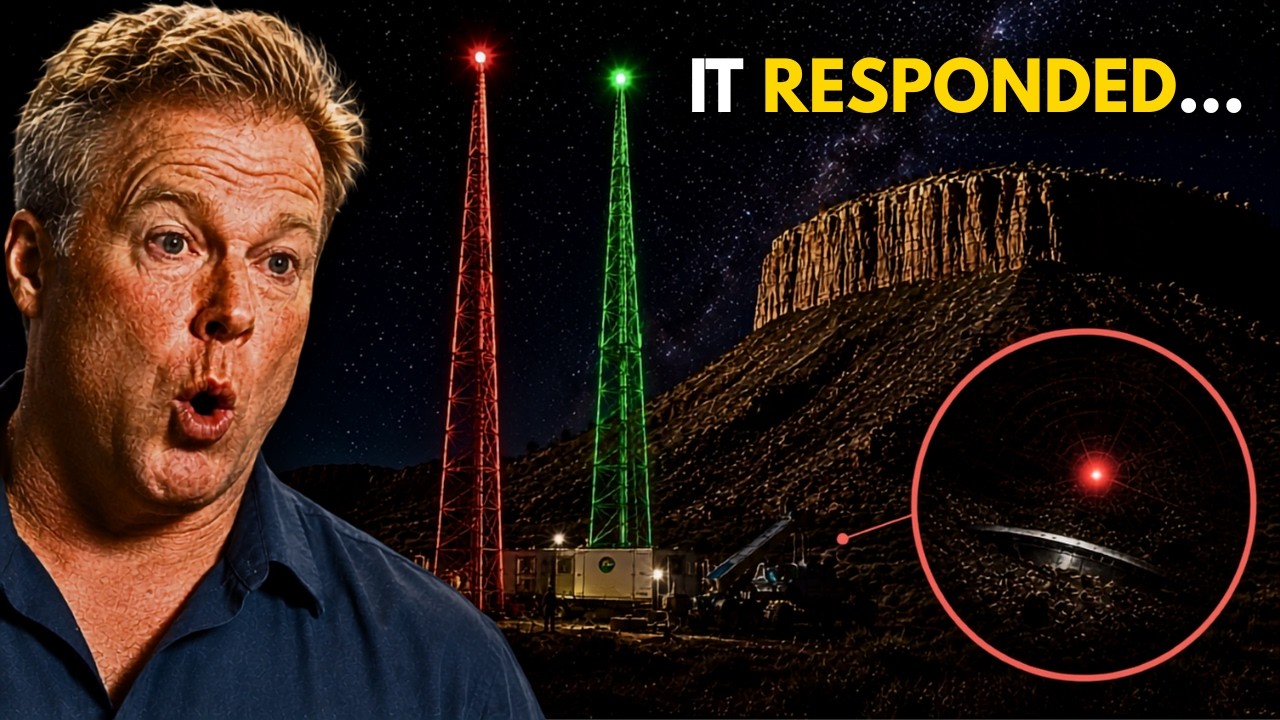
The Mesa Signal: Travis Taylor’s Discovery and the Growing Mystery Beneath Skinwalker Ranch
Over the years, astrophysicist and investigator Travis Taylor has reviewed countless datasets collected at Skinwalker Ranch. Most contained the kinds of anomalies researchers had grown accustomed to seeing: unusual sensor readings, brief electromagnetic spikes, and unexplained signatures that often disappeared before they could be fully understood.
But one dataset stood apart from the rest.
As newly collected MEA data appeared on analysts’ screens, a single signal immediately captured attention. At first glance, the anomaly seemed likely to have a conventional explanation. Scientific investigations routinely encounter equipment failures, calibration drift, and environmental interference that can create misleading results.
Yet this time, every attempt to explain the signal through ordinary technical causes failed.




Repeated scans revealed the same pattern. Instruments were recalibrated and tested. Independent analysts reviewed the measurements. The result remained unchanged.
Whatever was producing the anomaly, it appeared to be originating from beneath the mesa.
That consistency transformed what initially looked like a technical curiosity into one of the most intriguing discoveries of the investigation.
A Signal That Refused to Disappear
In scientific research, unusual readings are not uncommon.
What makes a result significant is repeatability.
A random error rarely occurs in precisely the same place over and over again. Sensor failures tend to produce inconsistent behavior. Environmental interference often shifts with changing conditions.
The signal beneath the mesa behaved differently.
Multiple scans continued detecting the anomaly in the same underground region. Different instruments produced comparable results. Independent analyses repeatedly pointed toward the same location.
As Taylor examined the growing body of evidence, the pattern became increasingly difficult to dismiss.
The investigation was no longer focused on determining whether the anomaly existed.
Instead, attention shifted toward a more challenging question:
Why was the same underground region producing the signal again and again?
Why the Mesa Matters
To understand why the discovery generated so much interest, it is important to understand the mesa’s role in the broader Skinwalker Ranch investigation.
For years, the mesa has occupied a central position in many of the ranch’s most puzzling observations.
Researchers have documented:
- Unusual underground signatures
- Recurring sensor anomalies
- Aerial phenomena occurring nearby
- Electromagnetic disturbances
- Radar irregularities
Different experiments conducted at different times have repeatedly pointed back toward the same general area.
While investigators still do not know what lies beneath the mesa, the accumulation of observations has elevated it from a location of interest to one of the primary focal points of the entire investigation.
The newly identified signal appeared to be emerging from that same region.
That fact alone significantly increased its importance.
Narrowing the Search
Finding an anomaly is only the first step.
Determining exactly where it originates is far more difficult.
To refine the target area, investigators reviewed high-resolution mapping data collected across multiple surveys. Layer by layer, researchers reconstructed a more detailed image of the subsurface environment beneath the mesa.
As additional datasets were compared, a notable pattern emerged.
The anomaly was not distributed across a broad area.
Instead, it appeared concentrated within a specific underground zone.
Historical scans were then brought into the analysis.
Remarkably, several older datasets appeared to contain similar signatures originating from the same location.
Individually, none of these observations provided a complete explanation.
Collectively, however, they suggested the presence of a persistent underground target.
For the first time, investigators could identify a relatively precise region where the signal appeared strongest.
The search area had narrowed dramatically.
Independent Verification
One of the most important stages of the investigation involved testing whether the anomaly could survive independent scrutiny.
Additional instruments were deployed.
Different systems examined the same underground coordinates using separate measurement techniques.
The outcome strengthened the team’s confidence.
Independent sensors continued detecting the same signal from the same location.
This consistency was critical.
Scientific conclusions become more persuasive when multiple methods produce comparable results.
A single sensor can fail.
Multiple independent systems reaching similar conclusions is considerably more difficult to explain away.
Although conventional possibilities such as geological effects and environmental influences remained under consideration, the anomaly had now survived multiple rounds of verification.
The evidence suggested that something genuine was being detected beneath the mesa.
What remained uncertain was its nature.
The Discovery of a Behavioral Pattern
At this stage, investigators began asking a new question.
The issue was no longer simply where the anomaly was located.
They wanted to know how it behaved.
To explore this possibility, researchers conducted controlled experiments while monitoring the underground target zone.
Various testing conditions were introduced, including specific transmitted frequencies.
During several of these experiments, sensors recorded stronger responses originating from the anomaly’s location.
The effect was not dramatic enough to immediately establish cause and effect.
However, it occurred often enough to attract serious attention.
Repeated testing suggested that certain experimental conditions might be associated with changes in the signal.
This raised a provocative possibility.
The anomaly was not merely present.
It appeared capable of responding.
That distinction represented a major shift in the investigation.
Challenging a Core Assumption
For much of the investigation, researchers operated under a seemingly reasonable assumption.
When unusual responses appeared in the data, they often coincided with active experiments.
Rockets were launched.
Frequencies were transmitted.
Equipment was operated.
Anomalous responses followed.
The pattern appeared straightforward.
Then Taylor discovered something unexpected while reviewing archived records.
Buried within older datasets was an event that closely resembled the anomaly currently under investigation.
The signal emerged from the same underground region.
The signature looked remarkably familiar.
There was only one problem.
No experiment was taking place.
No frequencies had been transmitted.
No rockets had launched.
No active testing was underway.
Yet the anomaly appeared anyway.
The discovery challenged one of the central assumptions guiding the investigation.
If the anomaly could appear during active testing, that was noteworthy.
If it could also appear spontaneously, the implications became far more complicated.
Researchers were forced to consider a new possibility:
External stimulation might not always be required.
What the Evidence Actually Shows
As intriguing as the findings are, investigators remain careful about distinguishing observations from conclusions.
Several statements can now be made with reasonable confidence:
Confirmed Observations
- Multiple systems have detected the anomaly.
- The signal consistently originates from the same underground region.
- Historical datasets contain similar signatures.
- The anomaly has survived repeated verification efforts.
- At least one occurrence appears unrelated to active testing.
Unanswered Questions
- What generates the signal?
- Is the source natural or artificial?
- Why does it appear concentrated in a specific location?
- Why do some testing conditions appear associated with stronger responses?
- Why does the anomaly occasionally appear without obvious triggers?
These questions remain unresolved.
The data demonstrates the existence of an anomaly.
It does not yet explain it.
Competing Explanations
Investigators currently consider several broad possibilities.
1. An Unusual Geological Formation
The most conventional explanation involves geology.
Natural underground formations can produce unexpected sensor readings. Mineral concentrations, subsurface voids, and complex rock structures can create unusual signatures.
This explanation has the advantage of requiring no extraordinary assumptions.
However, some researchers argue that it does not fully account for the anomaly’s consistency and apparent behavioral characteristics.
2. An Unknown Underground Structure
Another possibility is the existence of a physical structure buried within the mesa.
This interpretation attempts to explain:
- The localized nature of the anomaly
- Persistent signal generation
- Repeatable observations
- Correlations with other unusual measurements
At present, investigators have not produced definitive evidence confirming the presence of such a structure.
Nevertheless, the hypothesis remains under consideration.
3. A Poorly Understood Phenomenon
The third possibility is perhaps the most difficult to define.
Researchers may be observing a phenomenon that is not yet adequately understood within the context of current investigations.
This interpretation acknowledges the limitations of existing data while recognizing that no single conventional explanation currently accounts for every observation.
Its weakness, however, is obvious.
An unexplained phenomenon remains unexplained until a mechanism is identified.
A Pattern, Not an Answer
Perhaps the most important outcome of Travis Taylor’s analysis is not the discovery of a solution.
It is the discovery of a pattern.
Over time, investigators have:
- Identified a repeatable anomaly.
- Traced it to a specific underground region.
- Confirmed its presence through multiple observations.
- Documented behavior that appears responsive under certain conditions.
- Found evidence suggesting it can appear even without active stimulation.
Each finding strengthens the case that something unusual exists beneath the mesa.
None of them reveal exactly what that something is.
The latest investigation beneath the mesa has not solved the mystery of Skinwalker Ranch.
Instead, it has sharpened it.
The evidence now points toward a persistent underground anomaly that repeatedly appears in the same location, survives independent verification, and occasionally exhibits behavior that challenges researchers’ expectations.
Whether the source is geological, structural, environmental, or something not yet understood remains unknown.
What is clear is that investigators are no longer chasing isolated anomalies.
They are following a repeatable pattern.
And every new dataset seems to lead them back to the same place: a specific region beneath the mesa that continues to produce questions faster than it produces answers.
For Travis Taylor and the research team, the mystery is no longer whether something unusual is occurring beneath the mesa.
The mystery is what it is—and why it keeps appearing there.