LEAKED DATA: Did Travis Taylor Just Solve the 1.6 GHz Signal at Skinwalker Ranch?
LEAKED DATA: Did Travis Taylor Just Solve the 1.6 GHz Signal at Skinwalker Ranch?
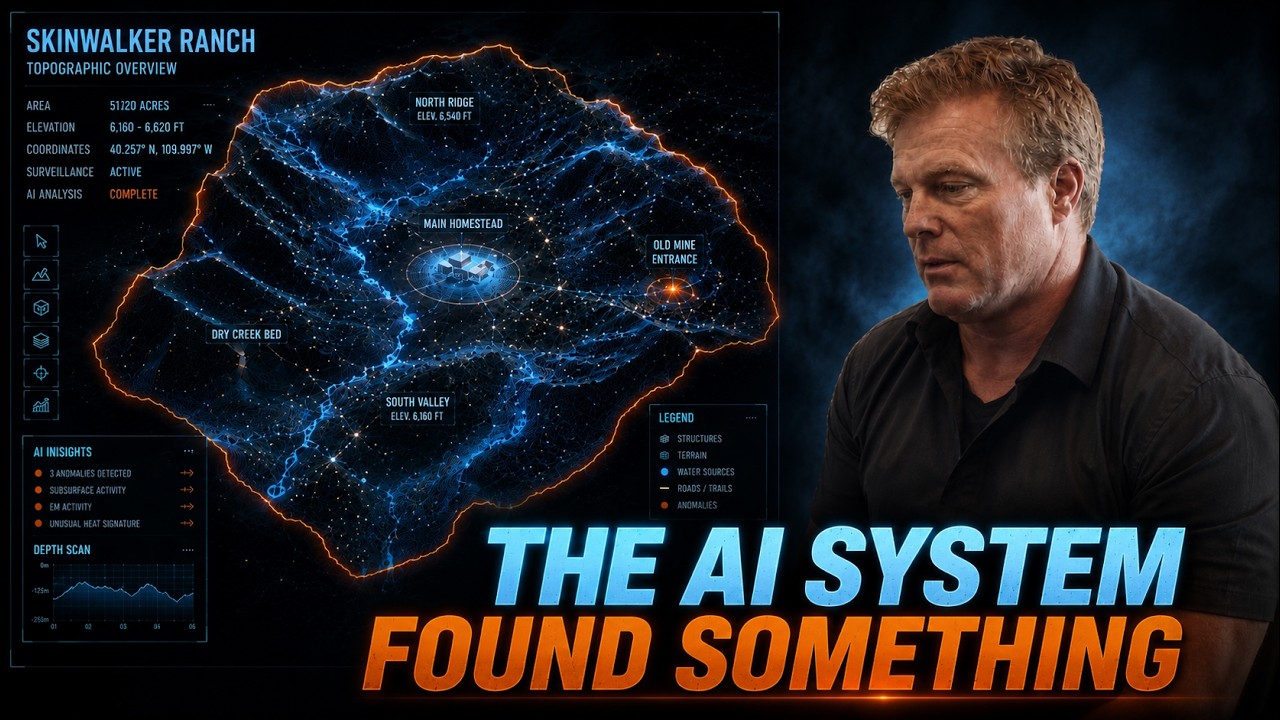
Skinwalker Ranch: Where Advanced Technology, Anomalous Physics, and Consciousness Theories Converge
Nestled within a 512-acre property in Utah’s Uinta Basin, Skinwalker Ranch has become one of the most controversial and heavily investigated locations associated with unexplained phenomena. Over the past decade, researchers have deployed increasingly sophisticated instrumentation to document reports of unusual electromagnetic disturbances, radiation spikes, aerial anomalies, GPS failures, and other events that appear difficult to reconcile with conventional explanations.
One of the most dramatic incidents occurred during a large-scale drone experiment. An illuminated swarm of drones was launched into the airspace above the ranch’s infamous “Triangle” region to map what researchers believed might be an invisible boundary. As the drones entered the target area, a powerful unmodulated radio-frequency signal reportedly emerged, disrupting navigation systems. Several drones operating on civilian GPS immediately lost positioning data and crashed. According to telemetry analysis, only a small number remained operational after automatically switching to alternative satellite navigation constellations associated with Russian and Chinese systems. The event fueled speculation that a localized phenomenon was selectively interfering with specific navigation frequencies.
Whether interpreted as evidence of unknown environmental effects or as indications of something more extraordinary, Skinwalker Ranch has become a focal point for investigations at the intersection of technology, physics, and human perception.
Building a High-Tech Observatory for the Unknown
Researchers working on the ranch long ago concluded that traditional scientific methods were insufficient for studying the reported phenomena. Single sensors and isolated instruments often produced incomplete or contradictory results. Observers noted that many events appeared transient, nonlinear, and sometimes seemingly responsive to both equipment and human presence.



To address these challenges, the ranch evolved into a sophisticated multi-sensor monitoring environment. A centralized command-and-control infrastructure was established to collect, synchronize, and analyze enormous volumes of real-time information from across the property.
The system integrates secure communication networks, field-deployed sensors, advanced visualization tools, and artificial intelligence-driven analytics. Researchers use ruggedized tablets connected through encrypted communications channels, continuously uploading field data to centralized processing systems. Interactive displays allow teams to visualize telemetry, annotate observations, and correlate multiple data streams simultaneously.
At the heart of the architecture is a machine-learning framework known as Athena (Advanced Technology Intelligence and Analytics), designed to process heterogeneous datasets and identify fleeting anomalies hidden within the environmental background noise of the Uinta Basin. The objective is not merely to record unusual events but to discover meaningful relationships between seemingly unrelated variables.
The Triangle: An Epicenter of Anomalous Activity
Among all locations on the ranch, one area consistently attracts the greatest scientific attention: the Triangle.
Researchers report that many unusual measurements appear concentrated within a roughly 600-meter-radius volume above this region. Over years of observation, several recurring anomalies have been documented.
GPS and GNSS Distortions
One of the most persistent observations involves disruptions to satellite navigation systems. Differential GPS arrays and RTK receivers have reportedly recorded sudden losses of satellite lock, unexpected positional shifts, and persistent navigation drift.
These anomalies create what investigators refer to as a “GNSS positioning bubble,” where normal navigation behavior becomes unreliable.
Laser Deflection and Extinction
Experiments using high-powered green and infrared lasers have produced reports of beams appearing to bend, weaken, or vanish entirely within specific altitudes above the ground.
Researchers have suggested that some atmospheric mechanism may be altering optical propagation in localized regions, though no widely accepted explanation has emerged.
The 1.6 GHz Signal
Perhaps the most frequently discussed anomaly is a narrow-band radio-frequency carrier near 1.6 GHz.
Spectrum analyzers and software-defined radios have repeatedly detected this signal during periods of heightened activity. Investigators claim that spikes in the signal often coincide with reports of unidentified aerial objects and episodes of severe GPS interference.
The signal’s apparent stability and recurring presence have made it one of the primary targets of ongoing investigation.
Radiation Bursts
Monitoring equipment has occasionally recorded transient gamma-ray increases and brief neutron detections. Some events reportedly exceeded 700 counts per minute and occurred near excavation sites or locations associated with unusual animal incidents.
Lidar Voids
Aerial lidar surveys have revealed what researchers describe as “void cones”—regions where sensor returns unexpectedly disappear. In these zones, lidar point clouds contain gaps that create the appearance of invisible vertical columns extending hundreds of meters into the sky.
Subsurface Anomalies
Ground-penetrating radar surveys and drilling operations have identified unusual underground structures within portions of the property. Researchers have reported encountering unexpectedly hard materials, ceramic-like fragments, and substances exhibiting unusual dielectric characteristics, though the origin of these materials remains uncertain.
The Drone Swarm Incident
One of the most striking demonstrations of these reported effects occurred during a large-scale drone deployment sometimes referred to as “Droneageddon.”
The experiment involved launching a coordinated swarm of illuminated drones into the Triangle to map the spatial boundaries of the anomaly zone.
As the swarm entered the area, monitoring equipment reportedly detected a strong radio-frequency emission centered near 1.6 GHz. Simultaneously, the electromagnetic noise floor across a broad spectrum increased significantly.
Moments later, multiple drones experienced catastrophic navigation failures.
According to investigators, machine-learning analysis of the flight telemetry produced a surprising result. The few drones that remained stable appeared to have switched away from conventional civilian GPS signals and were instead utilizing alternative satellite navigation systems. This observation led researchers to propose that the interference may have been highly frequency-specific rather than a general electromagnetic disturbance.
The incident remains one of the most frequently cited examples of the ranch’s alleged interaction with modern technology.
Biological and Environmental Mysteries
Reports from Skinwalker Ranch are not limited to electronics and instrumentation.
One frequently discussed incident involved the sudden death of a young cow. Veterinary analysis reportedly concluded that the animal suffered acute pneumonia associated with rapid physiological trauma. Surveillance footage allegedly captured a fast-moving dark object passing through the sky at approximately the same time as the animal’s death.
Another unusual event occurred at a location known as Homestead 2. During a ritual conducted by Rabbi Ariel Bar Tzadok, thermal imaging cameras recorded a sharply defined temperature drop within the structure. Researchers also reported observing an unexplained dark form and a small moving entity that appeared briefly before disappearing without leaving physical evidence.
Such events contribute to the ranch’s reputation as a location where environmental, biological, and psychological phenomena appear intertwined.
The Pulsed Piezo-Plasma Lens Hypothesis
To explain many of the electromagnetic anomalies, some researchers have proposed what is known as the Pulsed Piezo-Plasma Lens Model.
The theory begins with the geology of the Uinta Basin. The sandstone mesa overlooking the ranch contains substantial quartz deposits. Quartz possesses piezoelectric properties, meaning it can generate electrical potentials when subjected to mechanical stress.
According to the hypothesis, tectonic movements, thermal expansion, or drilling activities create stress within quartz-rich formations. This stress generates electrical charges that accumulate within subsurface fractures and conductive mineral pathways.
When local electric fields become sufficiently intense, they may ionize nearby air and create transient plasma formations.
Researchers suggest that these plasma layers could form between approximately 20 and 60 meters above the ground, creating temporary electromagnetic structures capable of:
- Distorting GPS signals
- Producing multipath reflections
- Bending laser beams
- Interfering with radio communications
- Affecting the trajectories of experimental rockets
Within this framework, many of the ranch’s technological anomalies emerge from unusual but ultimately physical geological and atmospheric processes.
Beyond Conventional Physics: Torsion and Consciousness Models
While plasma-based explanations may address electromagnetic effects, they do not account for reports often described as the “hitchhiker effect,” in which individuals claim unusual experiences continue after leaving the ranch.
To explore these reports, some theorists have turned to extended gravitational models based on Einstein-Cartan-Sciama gravity. Unlike standard general relativity, these theories incorporate spacetime torsion alongside curvature.
Proponents argue that torsion fields could provide a mechanism linking quantum spin, nonlocal correlations, and consciousness. Within this speculative framework, biological systems may become coupled to localized spacetime structures.
Advocates suggest that prolonged exposure to an anomalous torsion field could produce lingering cognitive or perceptual effects, potentially explaining reports of experiences following visitors away from the property.
It is important to note that such interpretations remain highly speculative and are not accepted within mainstream physics.
Ancient Symbolism and Modern Interpretation
Researchers have also drawn attention to ancient petroglyphs and symbolic markings found throughout the region.
Certain geometric motifs, spirals, and recurring numerical patterns have been interpreted as indicators of locations where unusual environmental conditions may occur. Some investigators propose that indigenous peoples may have recognized naturally occurring geophysical anomalies long before the arrival of modern scientific instruments.
In this view, traditional symbolic systems and contemporary sensor networks represent different methods of describing the same underlying environmental dynamics.
Whether this interpretation reflects genuine historical knowledge or retrospective pattern recognition remains a matter of debate.
Artificial Intelligence and the Search for Patterns
Perhaps the most innovative aspect of current Skinwalker Ranch research is the application of artificial intelligence.
Instead of examining isolated anomalies independently, machine-learning systems attempt to identify correlations across multiple domains simultaneously.
A single event might involve:
- Mechanical disturbances underground
- Electromagnetic fluctuations
- Atmospheric changes
- Radiation spikes
- GPS disruptions
- Human observations
By processing these variables together, neural networks can search for complex relationships that would be difficult for human analysts to recognize.
Researchers hope that such systems may eventually reveal whether the reported phenomena arise from unknown natural processes, instrumentation artifacts, human perception, or something entirely different.
Skinwalker Ranch occupies a unique place in contemporary anomalous research. It combines advanced surveillance technology, artificial intelligence, geophysical investigation, and speculative theoretical models in an attempt to understand a collection of persistent mysteries.
Some proposed explanations—such as piezoelectric effects, atmospheric plasma formation, and electromagnetic interference—fall within the realm of known physics, even if they remain unproven in this specific context. Others, including torsion-based consciousness theories and nonlocal observer interactions, extend far beyond established scientific consensus.
What makes Skinwalker Ranch particularly compelling is not any single claim but the convergence of technology, data collection, folklore, geology, and human experience. Whether future research ultimately validates extraordinary interpretations or reveals previously unknown natural mechanisms, the ranch continues to serve as one of the most ambitious attempts to investigate anomalous phenomena using modern scientific tools.
As the volume of collected data grows and analytical techniques become more sophisticated, the central question remains unresolved: are researchers documenting misunderstood environmental processes, or are they confronting phenomena that challenge current scientific understanding itself?