Oak Island Team DISCOVERS Hidden Tunnel Beneath Samuel Ball’s Property
Oak Island Team DISCOVERS Hidden Tunnel Beneath Samuel Ball’s Property
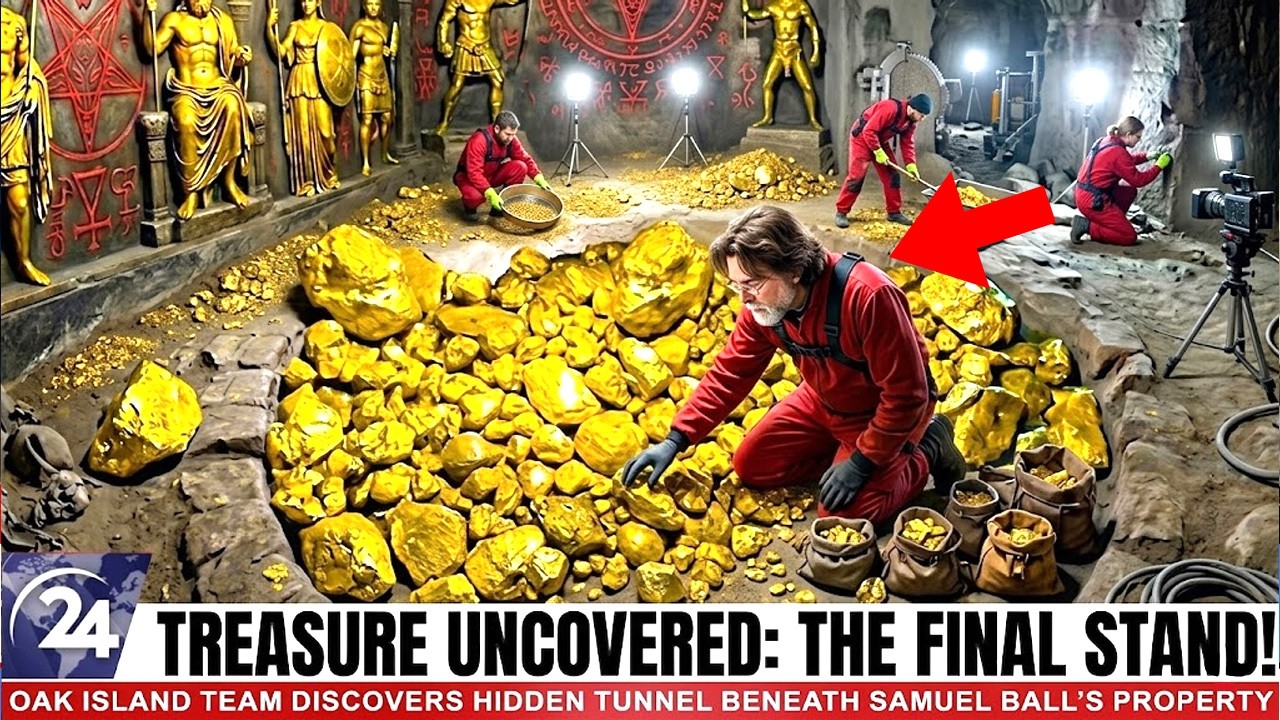
The Samuel Ball Tunnel: Oak Island’s Most Explosive Discovery Yet?
A Hidden Passage Beneath a Legendary Property
For more than 230 years, the mystery of Oak Island has captivated treasure hunters, historians, and archaeologists alike. Yet among all the theories surrounding hidden vaults, pirate treasure, and lost artifacts, one name continues to stand apart from the rest:
Samuel Ball.
A former enslaved man who arrived in Nova Scotia with virtually nothing after the American Revolution, Ball somehow became one of the wealthiest landowners in the region. His unexplained prosperity has fueled speculation for generations. Now, a startling discovery beneath the foundation of his former home may offer the strongest clue yet as to why.
The Oak Island team has confirmed the existence of a man-made underground void directly beneath the Samuel Ball property on Lot 25. Even more remarkable, the feature appears to be part of a carefully constructed tunnel system built with hand-cut stone and engineered precision.




For many observers, the discovery raises a question that has lingered for centuries:
Did Samuel Ball uncover Oak Island’s treasure long before anyone else?
Tracing the Island’s Earliest Searchers
The story began earlier in the day on neighboring Lot 21, near the historic McGinnis foundation.
There, Rick Lagina and metal-detecting expert Gary Drayton searched ground that had never been systematically explored by the modern team. The location carries special significance because it sits near the former home of Daniel McGinnis, the teenager traditionally credited with discovering the Money Pit in 1795.
Almost immediately, Gary’s detector began producing signals.
First came an old hand-cut screw.
Then fragments of iron.
Then a discovery that stopped both men in their tracks.
Emerging from the soil was an ornate brooch decorated with a deep red gemstone. Despite centuries underground, the artifact retained its striking appearance and intricate craftsmanship.
The find was particularly intriguing because it closely resembled another jeweled brooch discovered on nearby Lot 8 the previous year.
The implications were difficult to ignore.
If both objects predate nineteenth-century treasure-hunting activity, they may represent evidence of affluent visitors on Oak Island long before official settlement records suggest.
For Rick, the discovery reinforced a growing suspicion: someone with significant wealth may have been operating on the island generations before the famous treasure hunts began.
The Corridor Between Two Mysteries
Lot 21 occupies a fascinating position between two of Oak Island’s most enigmatic historical figures.
To the east lies the former property of Daniel McGinnis.
To the west sits the land once owned by Samuel Ball.
Both men lived on Oak Island during the late eighteenth century.
Both were connected to stories of buried treasure.
And both left behind mysteries that remain unresolved.
As Gary continued detecting, the team’s attention shifted toward another nearby area—Lot 12.
Initially believed to be little more than an old refuse dump, the site quickly yielded discoveries that challenged that assumption.
The Chest Hinges
Within minutes, Gary uncovered an ornate iron hinge unlike ordinary household hardware.
The decorative metalwork immediately reminded him of chest fittings recovered from Spanish shipwreck sites in Florida and the Caribbean.
Soon afterward, a second decorative hinge emerged from the same area.
Finding one such artifact might be coincidence.
Finding two within feet of each other suggested something more significant.
The discoveries immediately revived speculation surrounding the legendary missing treasure chests associated with Captain James Anderson, a figure frequently linked to Oak Island folklore.
Adding further intrigue was the memory of a mysterious skeleton key discovered decades earlier by long-time Oak Island researcher Fred Nolan.
For years, the key had lacked a matching lock.
Now, with chest hardware appearing nearby, some members of the team began wondering whether pieces of the same puzzle were finally coming together.
The Mystery of Samuel Ball
Despite the excitement surrounding the artifacts, all roads eventually led back to one man.
Samuel Ball.
Historical records confirm that Ball arrived in Nova Scotia in 1787 as a free Black Loyalist following service with British forces during the American Revolutionary War.
Like many former soldiers, he received a land grant.
Unlike most of his contemporaries, however, Ball went on to acquire additional properties and accumulate substantial wealth.
What makes his story remarkable is not merely that he became successful.
It is how successful he became.
Land transactions, legal documents, and financial records indicate that Ball possessed resources far beyond what historians would expect from a modest cabbage farmer.
Over time, researchers began asking an uncomfortable question.
Where did the money come from?
Theories have ranged from exceptionally successful farming to undiscovered business ventures.
Others believe he may have stumbled upon something far more valuable hidden beneath Oak Island itself.
The Radar Anomaly
Three years earlier, ground-penetrating radar surveys conducted on Lot 25 revealed a curious anomaly beneath the Ball property.
The scans indicated a hollow space below the surface.
At the time, the finding generated interest but remained unconfirmed.
Now, excavation has changed everything.
Archaeologist Laird Niven, accompanied by Jack Begley and Charles Barkhouse, carefully removed layers of stone above the anomaly.
What they uncovered was not a natural void.
Instead, beneath deliberately arranged stones lay a structured underground passage.
The walls appeared engineered.
The ceiling was flat.
The construction displayed a level of sophistication inconsistent with ordinary agricultural activity.
When Rick Lagina arrived at the site, his reaction spoke volumes.
The anomaly was real.
A Tunnel Built With Purpose
As excavation progressed, the underground feature became increasingly impressive.
The tunnel appeared to have been hand-cut and reinforced with carefully selected stone.
Every element suggested deliberate planning.
According to members of the team, structures of this type are not created accidentally.
They require labor, resources, and a clear objective.
“Tunnels aren’t built for nothing,” one investigator remarked.
The statement captured the mood surrounding the discovery.
If the passage had been intentionally constructed, then it must have led somewhere important.
The Borescope Investigation
The following day, the team returned with specialized equipment.
Using a flexible borescope camera, investigators began exploring portions of the tunnel inaccessible to humans.
Foot by foot, the camera advanced deeper into the darkness.
The images revealed stone walls extending far beyond the entrance.
The ceiling remained remarkably intact despite centuries underground.
Even more striking were visible tool marks left by the original builders.
At approximately fourteen and a half feet, the camera encountered an obstruction.
A large stone blocked further progress.
The object immediately became the focus of intense debate.
Was it simply debris that had fallen into the passage over time?
Or had someone intentionally placed it there as a seal?
The answer could determine whether the tunnel concealed something extraordinary beyond.
A Discovery Older Than Samuel Ball?
Perhaps the most controversial question concerns the age of the tunnel itself.
Recent seasons of investigation have produced several iron tools recovered from different locations across Oak Island.
According to metallurgical analysis cited by the team, some artifacts may date back several centuries before European settlement of the region.
If accurate, such findings would suggest that extensive underground activity occurred on Oak Island long before Samuel Ball ever arrived.
That possibility introduces two competing theories.
The first proposes that Ball himself built the tunnel and used it to conceal valuables.
The second suggests something even more remarkable.
Perhaps Ball discovered an ancient passage already hidden beneath his property and quietly benefited from whatever secrets it contained.
Supporters of the second theory point to the pattern of Ball’s wealth accumulation.
Historical records show a gradual increase over decades rather than a sudden financial windfall.
Some researchers argue that this pattern resembles someone drawing slowly from a fixed source rather than spending a single treasure hoard all at once.
The Question That Remains
As darkness settled over Oak Island, the team covered the excavation site and prepared to continue work the following day.
Yet one reality remained impossible to ignore.
The tunnel exists.
The radar anomaly was real.
The passage continues beyond the obstruction.
And somewhere beyond that barrier may lie the answer to one of the greatest mysteries in North American history.
Whether Samuel Ball constructed the tunnel, discovered it, or merely protected its secret, the evidence suggests that something significant lies at the end of the passage.
For now, the chamber remains hidden.
The destination remains unknown.
But after more than two centuries of speculation, Oak Island may finally be closer than ever to revealing what has been buried beneath its soil all along.