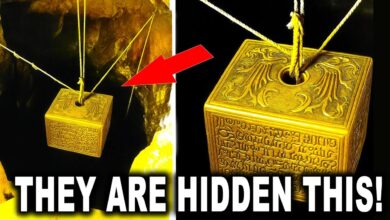
Oak Island Shocker: Rick Lagina Opens a Sealed Shaft Leading to a $95M Treasure
Oak Island Shocker: Rick Lagina Opens a Sealed Shaft Leading to a $95M Treasure
What if I told you this discovery was never meant to be found?
Hidden beneath Oak Island, Rick Lagginina has just uncovered a sealed shaft—
untouched, perfectly engineered, and pointing in only one direction.
Not down. Toward something.
Researchers believe this shaft may be a deliberate marker,
leading straight to a treasure horde estimated at $95 million.
But here’s the disturbing part.




This shaft was sealed on purpose,
as if whoever built it wanted to protect something
or keep people away.
No maps mention it.
No records explain it.
And yet, it sits exactly where the legend says
the final secret should be.
If this shaft is opened, it could finally prove
the Oak Island treasure is real—
or expose a truth far more dangerous.
Subscribe now and turn on notifications,
because what happens next could end a mystery
that has survived for over 200 years.
And trust me, you’ll want to stay until the end.
Rick Lagginina stands at the rim of a pit
that simply should not be there.
The crew has been clearing away collapsed soil
for only a few hours
when the excavator’s bucket suddenly jerks to a stop,
slamming into something solid, flat,
and clearly shaped by human hands.
As loose dirt spills away,
a clean stone edge slowly reveals itself,
buried beneath centuries of tightly packed earth.
No map marks a chamber in this spot.
No historical record even suggests one exists.
It feels as though someone deliberately built this entrance,
concealed it completely,
and then wiped every trace of it from the island’s memory.
When Rick runs his hand along the newly exposed stone,
he stops cold.
The tool marks carved into the surface aren’t crude
or worn down by time.
They are sharp, straight, and precise.
Cuts that look impossibly clean for something this old—
older than colonial tools—
yet far more refined than anything
that should still look this crisp underground.
Then comes the moment
that sends a chill through the entire team.
A thin stream of cold air slips out through the cracks,
but it isn’t the stale, dusty air
you’d expect from a buried cavity.
This breeze carries a faint
but unmistakable hint of salt water.
That alone makes no sense.
They are nearly 150 ft inland.
There is no reason sea air should be rising
from beneath their feet.
Rick leans in closer,
pulls out a laser level,
and checks the shaft’s angle.
His eyebrows rise instantly.
The shaft is perfectly vertical.
Not close.
Not roughly aligned.
Perfectly straight.
That kind of precision
is a known hallmark of early Templar engineering.
And just inside the stone rim,
hidden under layers of lichen and compacted silt,
runs a shallow carved groove.
It circles the shaft
like a resting place for something massive.
Something once slid into that track with intent.
Something designed to seal the opening
and keep out anyone
who didn’t know exactly what to look for.
Before the team can fully absorb what that means,
Marty calls Rick over.
Three tiny indentations sit on the stone face.
So subtle they’re almost invisible
unless you’re trained to notice them.
They form a perfect triangle.
They aren’t decorative.
They aren’t natural erosion.
These are placement markers.
When Marty taps one lightly with a chisel,
a dull metallic echo travels down the shaft.
That sound shouldn’t happen in solid rock.
It’s the kind of echo
you hear from a hollow space
lined with something forged
rather than carved.
Gary steps in with his scanner
and sweeps the area.
The device reacts immediately.
Non-ferrous metal is embedded inside the shaft wall.
Bronze, maybe brass—
possibly something similar—
but definitely not stone.
That’s when the realization hits.
This shaft was never meant to be opened
from the outside.
The entire locking system works in reverse.
Every mechanism,
every marker,
every clue
is designed for someone inside the chamber
to open it outward.
A vault meant to be exited,
not entered.
That makes no sense.
Unless this space wasn’t originally intended
as a vault at all—
or unless it contained something
so valuable or so dangerous
that its builders wanted absolute control
over who could ever reach it.
Rick drops to one knee beside a faint carving
near the lower stone edge.
At first glance, it looks like nothing more
than natural wear.
But when Gary splashes water across the surface,
a single partially erased symbol
slowly comes into view.
Rick recognizes it immediately.
It matches a mark discovered years earlier
on Lot 32—
a lead most people dismissed
as coincidence.
But now, seeing the same symbol
carved into a shaft that should not exist,
Rick feels something he rarely allows himself
to say out loud.
Certainty.
This isn’t random.
This is connected.