Top MOST OUTRAGEOUS Moments Of Season 5 (Pt 1) | The Secret of Skinwalker Ranch | History
Top MOST OUTRAGEOUS Moments Of Season 5 (Pt 1) | The Secret of Skinwalker Ranch | History
Hey, fellas, how are y’all?
-Good, Travis. -Good.
Well, Tim, here we are again.
Here we are.
Yeah, well, this time, we want to put that energy again into the space with your laser space canon and see if we can’t stimulate a response.
-Okay. -ERIK: Especially given what we saw last time.
-Yeah -You know, we haven’t told you guys about this yet, but when you had the laser space canons around the, uh, triangle here, what we saw in a long exposure photo, actually, several of them, uh, was up at about, uh, somewhere above, probably, say, 100 feet, something moved through the beam and blocked the beam.
And it’s huge, probably big as this tent.
-Well, that’s incredible. -TRAVIS: Passed through the beams.
So, it stops the beam, you have a big blob where there’s nothing, and the beam starts again.
-Wow. What-what could do that? -TRAVIS: What-what is that?
For tonight, we’re gonna follow up on that, as we always do.
We’re gonna collect data, not unlike what we did last time.
And, of course, I’ll have all the assets trained on these locations so that we get a secondary perspective if something does in fact show up in our space.
TRAVIS: Tonight, we’ll repeat the laser experiment with just one laser canon at the triangle to see if the same thing happens again.
Only this time, we’re also gonna launch rockets up through that 100-foot space to see what they might hit.
Are you ready to make it bright again?
I am. Let’s do it.
TRAVIS: We’re gonna go at dark. -Hey, Don. -There he is. -Welcome back.
We have something going on with the rockets.
We’re actually firing rockets straight up, right above that launch tower.
Literally, sparks are gonna fly.
Okay. All right.
All right, we’re gonna go do one last sort of safety sweep, and then I’ll give you guys a yell when the laser guys are ready to turn on.
-Okay. -Awesome.
I should probably get back over to the command center and make sure everything’s trained on this area.
Erik, I’ve got a walkie, so we’ll stay in close contact.
-All right, I got one, too. -Okay.
ERIK: We don’t know exactly what to expect, but we’re very interested in what we might see if we intersect something at that hundred-foot level or perhaps even as high as 5,000 feet. We’re directing the laser energy into the triangle, as we have in the past because it might stimulate a response based on our experience to date. I’ve got everything up and running, and, uh, I’m ready when you guys are.
Copy that.
TRAVIS: Okay, Tim, you’re ready to test.
TIM: Right. We’re ready. Laser’s coming on.
Lasers on. There you go.
uh, guys.
We are hitting something with the laser.
Y’all-y’all look.
THOMAS: Is that clouds?
I’m seeing stars.
Yeah, we’re hitting something.
You see the spot up there?
That’s… It should just be a beam.
What are we hitting?
DON: I have no idea.
It should be going higher than that.
I don’t think it should stop that low.
TRAVIS: Just after we turned on the Laser Space Cannon, the beam was cut off by an invisible obstruction. But rather than 100 feet high, like two nights ago, this was at a much higher altitude. So, is this something new?
Or is it something that moves from one spot to another?
TRAVIS (over walkie): Hey, Erik. Do you copy? ERIK: Yeah. Go ahead, Travis.
TRAVIS: We have turned on the space canon and it seems to be hitting something in the sky. ERIK: What in the hell?
Okay, okay, copy.
That is weird, man.
THOMAS: What the heck?
My camera just went out.
(sighs) The hell?
My camera…
-DON: It’s out? Something zapped it. -Uh…
This camera is just not working.
I pick up this night camera and for whatever reason, every time I pick this camera up and start to film something of interest, it shuts itself off.
I don’t know what’s going on with this camera. What’s going on there that would cause this equipment to malfunction? So while we were doing this, I went ahead and prepped a rocket with a chute in it.
If we have the mobile launch pad out here, I’m wondering if we ought not, while that laser’s hitting something, shoot a rocket up higher.
That’s a great idea. Let’s get it and go.
Dragon’s idea to launch a rocket up to where the laser was being blocked was perfectly timed. If we could get a rocket to hit that spot and something happened to it, maybe we could also finally get an image of whatever this obstruction was.
Erik, do you copy?
We’re gonna put a rocket through that spot right now.
Copy you. Thanks for that, Travis.
I’m gonna make sure I’ve got the cameras adjusted to, uh, capture the rocket launch. Thank you.
Hey, Thomas. Do you copy?
Yeah, Travis.
I’m up here on the mesa looking down on you, guys.
Copy that. Be advised we are about to launch a rocket.
Copy that. We’ll stay put until that rocket lands.
TRAVIS: Everybody, clear the area.
-Clear the area. -PETE: Okay, here we go.
Five, four, three, two, one.
-BRYANT: Did you see that thing take off? -TRAVIS: That thing took off and turned as far away from that laser beam as it could get.
-DON: Why didn’t it go straight? -TRAVIS: Good question.
We had that launch rail pretty much straight up, there’s no wind.
That thing took off and it, it avoided that laser beam like the plague, is what it looked like.
That thing completely took off away from the laser.
DON: Travis, there’s two bulbs on the end of the laser beam.
TRAVIS: That’s right, there sure is.
The laser split in two.
Oh, yeah, look, now there’s two.
I have never seen that before.
BRYANT: Are we actually hitting the anomaly with the laser?
TRAVIS: As if this experiment wasn’t already crazy enough, just after our rocket seemed to veer away from the triangle, the invisible obstruction that was blocking Nu-Salt’s laser suddenly looked like it was splitting the beam in two.
What was up there and was it now morphing into something else? Let’s bring the lasers down.
TIM: Lasers coming down.
TRAVIS: Tonight definitely didn’t go as we planned, but on the other hand, what we witnessed was beyond what we thought was possible. Tonight was special. There was a lot going on.
TRAVIS: Oh, there was something about tonight, -absolutely, I agree. -BRYANT: You’ve brought those laser cannons out here four years in a row now, and we’ve never seen one hit anything and stop.
That was… that was… that was new ground.
TRAVIS: And I can’t wait to see what the data tells us.
Yeah, it’s… it’s been a night.
TRAVIS: Hey, good night. Good night.
ERIK: Hey, guys.
Erik gathered us all in the command center to review Pete Kelsey’s processed data from our laser experiment last night at the triangle.
ERIK: So, what are we looking at here, Pete?
PETE: This is one of the terrestrial laser scans we did from our perspective at the triangle.
Okay.
PETE: We’re looking at an anomaly out in the east fields.
TRAVIS: What in the actual crap?
That is insane.
What would account for the sharp lines coming down?
PETE: I don’t know what it is.
But there had to be something there for the lidar to detect it.
Whatever is there is… is as if it’s invisible.
ERIK: I’m seeing the swirl marks.
TRAVIS: Yeah. Look at this.
What?
Look at this smear all around.
It’s like we’re inside a cone of something.
Can you look up?
-It does go into a cone. -KALEB: Whoa, look at that.
TRAVIS: It is a cone.
ERIK: Wow.
I mean, that is insane.
You’re inside it.
We’re all inside it.
Who’d have thought that, uh, a laser beam being stopped in midair would not be the strangest thing that we see.
(laughs) That’s right. Absolutely This is incredible.
This is the craziest thing I’ve ever seen.
If this turns out to be real measurements -of some real phenomena… -ERIK: Yeah.
then we’ve measured something nobody’s ever seen before, period, ever.
Think about what that would mean.
Yeah, that-that “if”…
is one really big “if.” Well, look, led by the data.
-That’s the data. -Dang right it is.
So we’ll put our heads together. This is amazing.
It’s gonna take me a while to get my head around this.
To process what I’ve just been shown.
-This is-this is fantastic. -Yeah, thank you, guys.
TRAVIS: Excellent work, man. -Great stuff. -ERIK: That is just amazing. ERIK: Well, welcome to the ranch, Ryan. Thanks for having me. Excited to be here.
-ERIK: Welcome back, Jay. -Thank you.
TRAVIS: …we met with two very special guests in the command center: Jay Stratton, my former boss on the UAP Task Force, who also oversaw Robert Bigelow’s investigation of the ranch back in the early 2000s, and Ryan Graves, a former Navy pilot, who recently testified before Congress as a UAP whistleblower. RYAN: I applaud you for what you guys are doing to actually see what’s out here.
TRAVIS: Well, with that in mind, we have a, uh, a-a fairly complex experiment planned.
And so, we’re hoping to get a lot of data from that tonight, and we’ll be happy to have you join us if you’re interested in, uh, maybe adding another set of the Mark One Eyeball sensor on-onto the, uh, onto the problem.
Absolutely, I’d love to. Thanks for having me.
This is great. Well, we got stuff to do.
Let’s get out there and get going. Hey, Dragon, Thomas? Do you guys copy?
Tonight, our friends from LOC Precision Rockets have designed two multi-rocket launching systems. One will be stationed at the triangle and the other will be over at the east field. Each station will conduct two rounds of four simultaneous rocket launches for a grand total of 16 rockets. The hope is that they might hit something in the air or trigger phenomena that will give us more data about what that massive cone we detected could possibly be.
All right.
Is that all four?
-Yep. -Are the lights on in that one?
Yep, lights are on.
TRAVIS: Meanwhile, we’ll be scanning the area with an infrared lidar drone as well as a FLIR thermal camera, which Ryan Graves will personally monitor to look for any signs of the cone-shaped anomaly or other phenomena that we might not be able to see with the naked eye.
Okay, does everybody know what we’re doing?
All right, let’s go. Let’s do it.
RYAN: I was tasked with monitoring the thermal camera. My experience monitoring the AT-FLIR in the F-18, uh, Travis thought it’d be a good idea for me to keep my eyes open on the FLIR to see if I could see anything that looked familiar. Okay, taking off.
Hey, Dragon, Thomas, you guys copy?
Yeah, go ahead, Travis.
TRAVIS (over walkie): We are very close. Uh, the lights are ready on the rockets.
We have a drone in the air.
Uh, Kaleb is about to start the lidar here.
Copy that.
I’m gonna go down and start that terrestrial scanner.
Okay, I’m gonna get out here where I can see you, guys.
All armed.
TRAVIS (over walkie): Rockets are going hot! THOMAS: Ten, nine, eight, seven, six, five, four, three, two, one. TRAVIS: Oh! Did you see that?
ALLEN: I see strobes.
KALEB: I’ve seen three.
TRAVIS: We got one lawn dart somewhere.
Okay, I only have two rockets in the air right now.
-Do y’all see the third one? -DAVE: Yeah, I got three.
Look at them go.
What’s weird is that one’s headed north and that one’s headed almost south.
DAVE: How does that work?
THOMAS: How can you have two chutes being blown different directions?
DAVE: They’re right next to each other.
TRAVIS: Oh, we got three in the valley here.
Whoa, they’re coming down slow.
Hey, Thomas, do you copy? Yeah, go ahead, Travis.
TRAVIS: We had four successful launches. Three of the chutes deployed properly. How did yours do?
Well, that’s very interesting.
We had four that launched, uh, on time.
We had two coming down right next to each other.
One got blown clear to the north and the one right next to it got blown to the south simultaneously.
DAVE: We’ve seen things here at Skinwalker Ranch that you just don’t see elsewhere. We’ve been doing this for over 30 years, and so when rockets start going a different direction than predicted, you kind of got to raise a hand and say, “Well, why did that happen?” But at Skinwalker Ranch, we’ve found out things are anything but normal trying to fly rockets.
And the answers don’t aways come easily. TRAVIS: Yeah, go ahead, Erik.
ERIK: Um, during the launches, the Kraken has been tracking a very consistent 1.6 gigahertz signal from the triangle, uh, down to the southern fence line.
TRAVIS: Wow, that’s kind of the direction the rockets went.
I’d love to have validation, uh, from your instruments out there and see if you’re picking up the same thing.
Okay, I’m running, um– I’m gonna turn this antenna.
Erik says it’s to the south.
Yeah.
That is really weird.
So we’re getting some kind of signal, and that’s the antenna that’s pointed back here where Erik said there was something -coming up on the Kraken. -Yeah.
TRAVIS: Erik, let’s keep an eye on that. Understood, Travis.
I’m watching.
The Kraken antenna array system, whose purpose is to direction find and tell us where signals are coming from, indicates that we have a source of 1.6 gigahertz electromagnetic radiation that is, in fact, to the south and west of the ranch.
Now, why would that be happening? As far as we can tell, there’s nothing from what would be south of the fence line that should account for that. TRAVIS (over walkie): All right, be advised. I think this is gonna be our last launch for the evening. Copy that.
TRAVIS (over walkie): Hey, can we get everybody back into position for our next test, please? All right, guys.
-Thomas, you calling? -THOMAS (over walkie): Yeah. Five, four, three, two, one.
TRAVIS: We have four rockets.
One chute.
Oh, I only see one chute.
Two, three, four. We got all four chutes.
Yeah, I can see theirs, too.
They’re coming right down on top of us.
Oh, what’s that?
Right there. What’s that?
We got something, Travis.
You found something?
Yeah, it was in the cloud layer up here, and it was descending down.
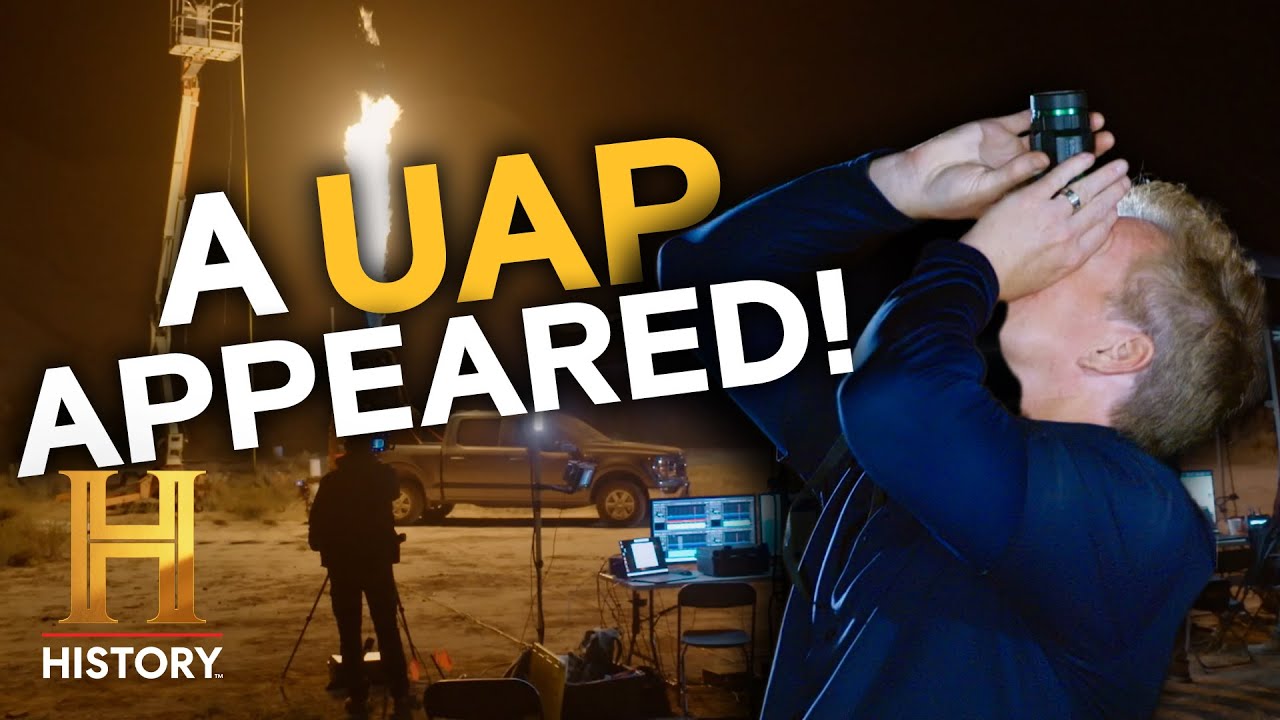
Just after launching our second series of eight rockets between the east field and the triangle, former Navy pilot Ryan Graves spotted a UAP in the sky on our thermal camera. No one else happened to see it in the moment, but then Erik confirmed that his ADS-B system, which tracks conventional aircraft within 150 miles of the ranch, didn’t pick it up either.
So if it wasn’t an airplane, what the heck did Ryan see?
PETE: We got to watch that again.
-TRAVIS: That’s moving fast. -RYAN: Yeah.
TRAVIS: Then you see it turn, too.
-It looked like it did a maneuver. -RYAN: It did. Yep.
That thing is moving fast.
Those clouds are five miles away at least.
So that thing is moving.
And to the northeast again.
TRAVIS: And to the northeast. Yeah, right there.
Right there at the, uh, in-and-out spot.
Kind of looked like it was diving down.
TRAVIS: Absolutely did.
That’s a great catch.
It looked like it went behind the clouds, didn’t it?
This UAP, whatever it was, descended right down toward the mesa, and then seemed to disappear right where we’ve previously recorded video of other UAPs exiting the mesa and then flying right toward the triangle. Erik Bard.
I don’t know if it’s connected to the huge cone-shaped anomaly, but it definitely appeared within its boundaries.
So, what could it have been?
Well, I think we got a lot of data.
Did I hear right that one of you guys caught something flying into the mesa?
Ryan saw it on, uh, thermal while Pete was flying the drone.
-Towards the out? -TRAVIS: Yeah, right by the out.
And it made a maneuver, too, as it came down.
-It made a big turn. -It did. It did. -Oh, wow.
-It made a jog to the east. -Oh, wow.
Yeah, I’m gonna say it was moving really fast.
RYAN: I think it’s very important that they continue doing what they’re doing here at the ranch, because at the end of the day, we’re really only gonna be able to understand this if we’re able to understand in a repeatable manner.
You know, they seem to be getting data here.
There seems to be something that is happening.
It started pretty high up in the sky, and it was moving down pretty quick.
I would be thrilled to continue to work with the team to help figure out what this is, and we can continue the conversation and gather data. You know, on my display, I see an indication of where that 1.6 gigahertz is coming from, and throughout our entire exercise tonight, it’s been pointing predominantly, you know, out that way somewhere.
That sounds really odd.
But, uh, I’m ready to break it down.
All right, well, you know, I think it’s a-a great experiment.
Yeah, and thanks again for all you guys being here.
We appreciate it.
TRAVIS: All right. -Hey, Cam. -Hey.
TRAVIS: …Cameron Fugal arrived to help us conduct our last, and most ambitious, experiment of the year.
Well, the lidar trucks are coming down the road.
And we also welcomed a whole team of lidar experts, including Pete Kelsey, John Brown, Jim Royston and Sam Deriso. ERIK: Well, before we jump in to what we’re planning on doing, this looks like some serious tech.
JOHN: It’s pretty serious technology when it comes to lidar.
This one is specifically used for long-distance collection.
ERIK: Okay.
And it’s incredibly accurate.
Once the sun goes down, we’ll start the experiment by launching a rocket in the east field to see if we can stimulate phenomena. From there, imaging expert John Brown will drive his mobile lidar vehicle, while Cameron Fugal shadows him in the helicopter. They’ll move past the east field, the triangle, the mesa drill site and over to Homestead Two. John will be scanning the entire area between the ground and the helicopter for signs of the cone or any other strange things. Then, after that experiment is done, we’re going to do an experiment at the triangle.
Yeah, let… let me describe that.
We’re going to have the burner from a hot-air balloon heating up that space where we have detected something at an altitude of about 30 feet.
And we’ll be doing some thermal and lidar imaging on that.
So, we’ll be using a hot-air balloon burner to blast flames into that 31-foot region while we scan it with lidar devices and record it with high-speed, night vision, thermal and infrared cameras. And all during the experiment, we’ll be monitoring numerous spectrum analyzers, radiation detectors and GPS devices to collect more data than we ever have before.
This place has been hiding its secrets from us for more than five years now. But tonight, we intend to finally reveal just what they truly are. CAMERON: So, as serious as this is, this is exciting, too.
-Oh, it’s very exciting. -Oh, yeah, very.
And we have a lot of work to do.
CAMERON: It’s a super science project tonight.
We have a lot to do.
Well, guys, I can see our shadows are getting awfully long.
I think it’s time to get out there, get set up and get ready to go.
Yup. Let’s get to work.
-We got to go. -ERIK: Okay.
CAMERON: Okay, we’re going to get airborne. TRAVIS: All right, looks like Cameron’s up.
Sam, do you copy?
SAM: Yes, so we have just entered the gate. We are ready.
TRAVIS: Just after nightfall, Cameron Fugal lifted off in the helicopter to get positioned 1,000 feet above John Brown’s mobile lidar truck at the eastern gate. It was time to start our ranch-wide experiment.
Cameron, are you in place? We’re going to go in five, four– -BRYANT: Three, two. -Three, two.
One.
There it goes. Rocket’s up.
BRYANT: We had a good launch, good chute, and you can send them on their way.
Tell him let’s go, we’re good.
TRAVIS: All right, here they come.
Right after Dragon launched his rocket, John Brown began driving his lidar truck from east to west across the ranch while Cameron was positioned right above him, flying at an altitude of 1,000 feet. TRAVIS (over radio): Copy that, Sam, go all the way to the gate and turn back around. THOMAS: Lidar truck just passed the drill site, proceeding to the triangle, over.
TRAVIS: Copy that, Thomas. TRAVIS: Everybody, be advised that, uh, the lidar truck is passing through the triangle right now.
THOMAS: Just curious, is the helicopter, uh, does he think he’s directly over the lidar truck?
‘Cause he’s directly over the drill site right now.
TRAVIS: Yeah, that’s a good question, Thomas.
He’s way behind the lidar truck.
I don’t know– something’s going on.
Yeah, I can confirm, that’s exactly what I saw here.
Behind them?
(chuckles): There’s no way.
Okay, now this was really odd. Cameron said, according to what he was seeing, he was tracking directly above the lidar truck as they headed back east past the triangle. But we could all see the helicopter positioned way behind the truck and much closer to the mesa drill site. So, were our eyes being deceived or his?
It made no sense.
TRAVIS: As Steve Jones prepared to start shooting flames up above the triangle… We’re running, lidar’s running.
…we activated our stationary and handheld lidar devices.
-I’m live. -Oh, you’re up.
Then, Pete Kelsey got his thermal camera drone in the air, and we also started recording with a FLIR thermal camera on the ground. TRAVIS (over radio): Go ahead and do a run, Sam. 10-4, we’re a-going.
TRAVIS: Steve, you copy? Copy.
TRAVIS: Are you ready to go? STEVE (over radio): Yes, sir. All right, we’re gonna go in five, four, three, two, one…
Whoa!
(static hissing) TRAVIS: Three, two, one, stop.
How can fire cause static on the radio? That’s crazy.
Go.
It made me wonder if the flames that were directly hitting the 31-foot blob zone at the triangle were somehow triggering more phenomena that was affecting the helicopter. So, we needed Steve Jones to shoot more flames to see if it would keep happening or possibly stimulate something even stranger. Stop.
-KALEB: Whoa, what was that? -BOBBY: I don’t know, something just went right across the mesa like that.
-Yeah. -It looked like it was right in front of the…
-Like a band just went across. -Yeah.
KALEB: I’m looking at this monitor and I see almost like a-a fog or a field of some kind moving across the mesa and we don’t know what it is. Hopefully, Erik caught some more video footage of it in his cameras and we can figure out exactly what that is. TRAVIS (over radio): Hey, Steve, we’re gonna do one more burn. STEVE: Copy that.
Three, two, one, go.
KALEB: Right there, it just did it again. ROYSTON: I saw it again. (burner whooshing) TRAVIS: Two, one, stop.
Looks like a smoke ring, like a donut.
It looked like it was going along the side of something.
Yeah, there was that little section right there on the edge.
And it looked like it hit something and, like… -BOBBY: And it went around it. -KALEB: Yeah. Kaleb, did you say you saw something in the scanner?
Well, so, a couple things.
When, uh, Steve was making the flare go…
-Mm-hmm. -…it looked like there was, like, a circle that kind of went around.
And it almost like it followed the edge of a bowl.
Oh, wow.
And Pete had the drone come back out and we saw two different things look like they went across the screen.
But they, almost like they were distorted.
-All right. -So…
We’ll absolutely look at that. That’s awesome.
It was odd that the flames might’ve possibly affected Cameron’s comms system in the helicopter nearly 5,000 feet above the triangle.
But when the guys saw a distorted shadow move across the face of the mesa on Pete’s thermal camera screen, and then the flames appeared to wrap around an invisible object right at the 31-foot blob level, it seemed like we were definitely getting responses from something on the ranch. The question was, just what could it be?
We reset everything on the SLAM scanner and so the next experiment, we’ll… I’ll try and scan again and I’m gonna try and do that same pattern -around the triangle, so… -Okay.
-Isn’t that bizarre? -Yeah.
Okay, just confirming, you did see two smaller orbs.
-Correct? -Yes!
All right.
-That’s awesome. -Okay, Travis says it’s awesome.
And I bet you Erik will be looking forward to seeing that data, Cameron.
TRAVIS: None of us could see any signs of the UAPs that Cameron– who was wearing night vision goggles– was reporting flying all around the helicopter nearly 5,000 feet directly above the triangle. But from the tone in his voice, we could all tell he was definitely seeing something that had no conventional explanation.
ERIK: I think we’ve accomplished just about every single one of our objectives tonight.
-Correct. -TRAVIS: We did get a lot of data.
In fact, what we’ve done tonight has probably generated more data than any other data collection exercise that we’ve done in a single evening.
Dude, you’re right.
We’ve got more data points to go through right now than we’ve had probably in the entire summation of the five years that I’ve been here.
That’s daunting to even think about.
That’s an insurmountable task, but hey, look, you know, it’s late, we still got to break down and put stuff up.
So I say we divide and conquer and let’s get out of here.
-Feels like it’s almost time to get up. -Yeah, it is.